Saturday, June 3, 2023

Grounded

Goblin Gardener card art
In Magic, lands matter. A good deal. This month, I'll focus on this card type, referencing the comprehensive rules to do so.

Lands make up ~40% of a given Magic deck, and a deck may contain any number of basic land cards. Other cards are limited to 4 copies (in most variants) or 1 copy (in singleton variants like Commander).

There are two types of lands: basic and nonbasic. The relevant rules:
205.4c Any land with the supertype “basic” is a basic land. Any land that doesn’t have this supertype is a nonbasic land, even if it has a basic land type. 

305.5. Land subtypes are always a single word and are listed after a long dash. Land subtypes are also called land types. Lands may have multiple subtypes. See rule 205.3i for the complete list of land types. Example: “Basic Land — Mountain” means the card is a land with the subtype Mountain. 

305.6. The basic land types are Plains, Island, Swamp, Mountain, and Forest. If an object uses the words “basic land type,” it’s referring to one of these subtypes. An object with the land card type and a basic land type has the intrinsic ability “{T}: Add [mana symbol],” even if the text box doesn’t actually contain that text or the object has no text box. For Plains, [mana symbol] is {W}; for Islands, {U}; for Swamps, {B}; for Mountains, {R}; and for Forests, {G}. See rule 107.4a. See also rule 605, “Mana Abilities.” 

305.8. Any land with the supertype “basic” is a basic land. Any land that doesn’t have this supertype is a nonbasic land, even if it has a basic land type.
Note: older sets (prior to Eighth edition) "didn’t use the word “basic” to indicate a basic land. Cards from those sets with the following names are basic lands and have received errata in the Oracle card reference accordingly: Forest, Island, Mountain, Plains, Swamp, Snow-Covered Forest, Snow-Covered Island, Snow-Covered Mountain, Snow-Covered Plains, and Snow-Covered Swamp."

Don't forget Wastes! This card is a basic land type but with no subtype, which is why it is not mentioned above.

As lands are the resources in the game, powerful ones (some nonbasic lands) can be expensive. More on that later this month. For today, I want to highlight the difference between cards that reference basic lands vs. cards that reference basic land subtype(s). I'll choose one basic land—Forest—as an example. 

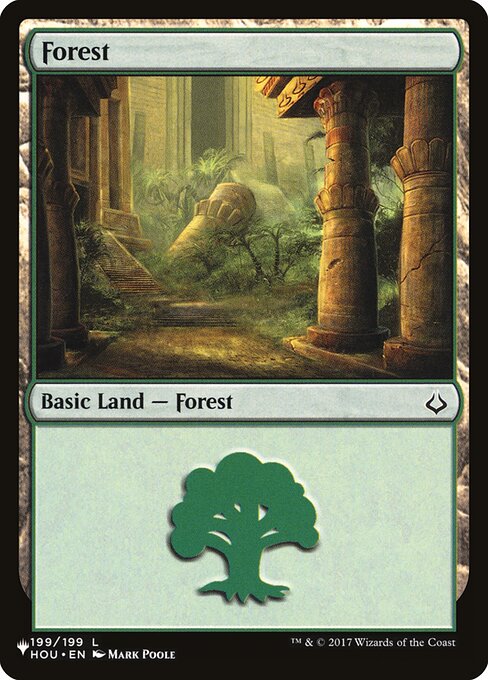
There are 33 types of forests in the game. Two are basic: 
The rest are nonbasic. Four examples:

In my above examples, each of the nonbasic lands has two or three subtypes. Forest is always one, with other basic land types being the others. 

There are many cards in Magic that allow you to search your deck for lands. Pay attention to the wording for what it is allowing you to seek:
In the above example, Ranger's Path enables you to get two Forest cards and put them onto the battlefield tapped, while Cultivate enables you to get two basic land cards, put one onto the battlefield tapped, and the other into your hand. Note the difference, and the power, of the wording. 
- Ranger's Path enables you to get even nonbasic lands so long as one of their subtypes is Forest (any of the examples I showed above). You could choose Spara's Headquarters and Wooded Ridgeline, giving you access to four colors of mana on the next turn.
- Cultivate enables you to get any kind of basic land, but only basic. So you could choose one Swamp and one Mountain, but not a nonbasic land like Woodland Chasm.

Other cards like Three Visits or Blanchwood Armor do similar things; both trigger off Forest cards (and not only basic land Forests).  
And cards like Farseek enable you to get any land who has a subtype of Plains, Island, Swamp, or Mountain:
Some cards, like Crop Rotation, enable you to get any land card (basic or nonbasic) from your library:
This is obviously powerful (and a key card in landfall decks), though you must sacrifice a land as an additional cost.

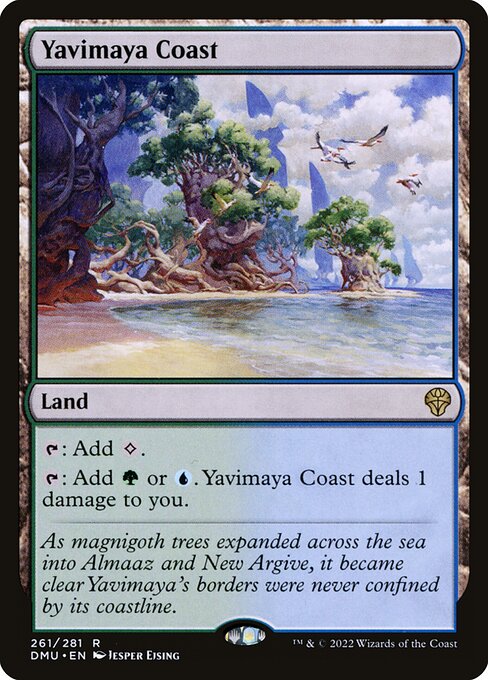
A land needn't have a subtype of Forest to produce green mana. Yavimaya Coast, for example, produces one green or blue mana but does not have the Forest or Island subtypes. Since it is a nonbasic land, none of the cards listed above, except for Crop Rotation, could search for it.
As you build your decks and think about lands (and cards that search for them) to include, look closely at wording and subtypes. They make all the difference.

Wednesday, May 31, 2023

Card Talk 4

Arni Metalbrow card art
Today is the fourth post in my Card Talk series.

Reminder on how Card Talk works:
  • I go to Scryfall and select 'Random Card'
  • I present and blog about the card. I could discuss any aspect: the art, abilities, cost, set, impact on the game, and so on. Stream of consciousness.
Card Talk is a fun, uncurated way to look at Magic's cards, mechanics, history, art, sets, and so on. And of course it exposes some of my own preferences, biases, and memories of the game. 

Today's card is . . .

Rubinia Soulsinger
Hmmm. A multi-colored legendary creature from Commander 2013. But not originally; she was first printed in Legends and reprinted several times thereafter.

I like legendary creatures so much that I dedicated a month of posts to them. And I enjoy multi-colored ones in particular; those gold-bordered cards caught my eye when first playing Magic (I enjoyed the Chronicles set because of them). They are visually pleasing, and often powerful to boot. Rubinia is no exception.

Rubinia's power is in her ability, allowing you to gain control of an opponent's creature (for as long as you like, if you can keep Rubinia alive). And you can exchange control for another creature if a more powerful one hits the board. What a great way to take your opponent's weapon and turn it against them. 

I don't know how much play Rubinia sees; her cost suggests "not much." (More recent reprints go for less than $0.40.) She is an easy target, with only 3 toughness, and would die to many removal spells. Still, she would be a fun addition to casual drafts or decks.

This version of Rubinia appeared in Commander 2013, which was a set of five preconstructed multi-colored commander decks. Wizards started their Commander series in 2011, releasing preconstructed decks as a way to gain interest in the Commander format, introduce new cards specifically designed for the format, and reprint important cards to make them accessible. Some commander products have greatly increased in value over the years; more recent offerings are on the weaker side.

Monday, May 29, 2023

Card Talk 3

Arni Metalbrow card art
Today is the third post in my Card Talk series.

Reminder on how Card Talk works:
  • I go to Scryfall and select 'Random Card'
  • I present and blog about the card. I could discuss any aspect: the art, abilities, cost, set, impact on the game, and so on. Stream of consciousness.
For me, Card Talk is a fun, uncurated way to look at Magic's cards, mechanics, history, art, sets, and so on. And of course it exposes some of my own preferences, biases, and memories of the game. 

Today's card is . . .

Wingfold Pteron
Hmmm. A blue dinosaur from Ikoria.

Ikoria: Lair of Behemoths was the first set released in the pandemic (it came out in April 2020). I was initially excited at what the name implied—I love big creatures—but my anticipation waned as the previews came out. I didn't care for the mutate mechanic (it was complex in paper) and other elements of the set annoyed me, too, as I discuss here. The set is probably most remembered for the 'companion' debacle, where the companion ability (found on 10 cards in the set) was far too powerful and forced a rules change shortly after the set was released.
Original companion rules text: 
(If this card is your chosen companion, you may cast it once from outside the game.)
Adjusted rules text: 
(If this card is your chosen companion, you may put it into your hand from outside the game for {3} as a sorcery.)
Anyway, back to the blue dinosaur.

Dinosaurs came to prominence with Ixalan's release (2017). Though about 170 dinos have been released to date, only three are mono-blue.

Note Wingfold Pteron's enter the battlefield ability: a choice of counters. Ikoria was the first (and I think only) set to introduce counters that were 'ability' counters: counters that gave your creature an ability (like flying or hexproof, in this case). While I like the concept, in paper that gets hard to track. Ikoria may have been the first set, between mutate and ability counters, that indicated Wizards might be focusing more on digital Magic. Digitally, things like this are easy and cool. 

Final comment: I don't recall seeing this card before. That's one thing I enjoy about Magic: you can be aware of a set, and have studied many cards in it, but still be surprised by ones you never noticed before. There is a lot to explore here.

Friday, May 26, 2023

Card Talk 2

Arni Metalbrow card art
Today is the second post in my Card Talk series.

Reminder on how Card Talk works:
  • I go to Scryfall and select 'Random Card'
  • I present and blog about the card. I could discuss any aspect: the art, abilities, cost, set, impact on the game, and so on. Stream of consciousness.
For me, Card Talk is a fun, uncurated way to look at Magic's cards, mechanics, history, art, sets, and so on. And of course it exposes some of my own preferences, biases, and memories of the game. 

Today's card is . . .

Pestilence Rats
Rats. Another black card. Anyway . . .

Magic has a fair number of rat creature cards (73 as of this post). Almost all are mono-black; five are either white/black, blue/black, or black/red. But you get the point: rats are evil little creatures. A handful of rats have discard or exile effects, but I will focus on a more intuitive ability for this creature: strength in numbers.

Pestilence Rats gets stronger when other rats are on the battlefield. Anyone's rats—even those controlled by other players. This "even opponents' creatures matter" theme is typical of older tribal cards (see Lord of Atlantis or Elvish Champion as examples). More recent cards in this vein tend to focus on your creature only (Blex, Vexing Pest or Captivating Vampire). But I digress.

Rats like other rats, so casual decks focusing on this creature might include Pack Rat, Rat Colony, Plague Rats, or Relentless Rats. Two of those (Rat ColonyRelentless Rats) let you violate the "only 4 copies of any card" rule. (I have a fun blue-black rat deck featuring 20 Rat Colony pairing with Tetsuko Umezawa, Fugivite to make them unblockable.) 

Pestilence Rats came out of Ice Age. Released in 1995, I was getting into Magic around that time, and Ice Age helped draw me in—I loved the packaging art (see below).
image from here
The art was cool, but the set wasn't; Ice Age had cards that were too wordy and too weak. Even today, the most valuable card from the set goes for just over $30; most other sets in that era are far more valuable. And Pestilence Rats is an example of that: it is underpowered for its mana cost (and still cheap; you can get a copy for $0.34 even though it was never reprinted). To have any hope of viability, you would need 4 copies in your deck and require one (or more) opponents to have the same. Almost certainly will not happen.

Speaking of art, this artwork was done by Jeff Menges, who drew 58 Magic cards, 15 of which were in the first set, Alpha. His Black Knight, Grizzly Bears, Bog Wraith, Merfolk of the Pearl Trident, and Swords to Plowshares stand out to me.

What I like most about Pestilence Rats? The set it belongs to and the associated memories. I do not think I own the card, and would never play it if I did.

Sunday, May 21, 2023

Card Talk 1

Arni Metalbrow card art
It's been a slow few months for Magic in this house. I haven't enjoyed, collected, or played the last few sets (save exposure to them on Magic Arena), and have been involved in other tasks that have dominated my time. But I haven't forgotten about this game, and so today I kick off a series I've been thinking about for some time: Card Talk.

Here is how Card Talk works:
  • I go to Scryfall and select 'Random Card'
  • I present and blog about the card. I could discuss any aspect: the art, abilities, cost, set, impact on the game, and so on. Stream of consciousness.
Card Talk should be a fun, uncurated way to look at cards throughout Magic's history. And it should reveal some of my own preferences, biases, and memories of the game. Here goes. The first card in this series is . . .

Demon of Dark Schemes
Ugh. I am not excited that this was the first card, for two reasons. 

First: I never played this card, nor enjoyed this set. Kaladesh was released in September 2016. The first of a two-set block (Aether Revolt followed in January 2017). Set on a then-new plane, it had a steam punk motif that I didn't particularly enjoy. Nor did I like the energy counter concept (which you see on today's card). Energy counters were just 'one more thing to track' and I felt they did not add enough benefit to the game to warrant use. Kaladesh was significant for another reason, though; it introduced a new card subtype: vehicle. (Mark Rosewater talks about that process here.) Vehicles are artifacts that become artifact creatures when 'piloted.' The ability is called 'crew' and reads as follows on all vehicles:
Crew [x] (Tap any number of creatures you control with total power [x] or more: This Vehicle becomes an artifact creature until end of turn.)
Second: demons are creature types that upset some people. I am a Christian; I believe angels and demons exist. So it is easy to get antsy when I see card types like this. Nevertheless, Magic is a card game that makes no attempt to be imitative: it is fantasy with no desired connections to real-world beings. On my other blog, I discuss how Christians should approach content consumption. That summary post links to other posts in the series including guidelines for evaluating things like fantasy and games. Following those guidelines, I relax a bit. In Magic, the color black represents evil, and it is okay to play a game and be the bad guy because games are closed environments (read the linked article for more). That said, I still prefer my white angel deck.

Other card observations:
  • The date embossed in gold indicates that this is a prerelease card; it appeared as a single card in a prerelease kit, which is a box containing 6 packs plus one single card (and one die). Prerelease kits are sold one week before set release at local game stores, enabling players to explore the new set by playing sealed format (you have six packs and build a 40-card deck out of those cards, adding basic lands).
  • Ignoring the energy ability, this card is still pretty powerful. Six mana for a 5/5 flyer isn't bad, and its 'enter the battlefield' ability can board wipe some deck archetypes (like red burn or white weenie). 

Saturday, April 29, 2023

The First Shall be Last

Fblthp, the Lost card art
This week, I came across this article. The headline (below) is hilarious and the entire article may be satire:
Powerful, Strategic Deck Decimated by Opponent’s ‘Have a Lot of Monsters’ Strategy
But it points out a fun truth worthy of reflection: an unskilled beginner can, at times, produce a deck that consistently takes down carefully designed decks.

I have previously blogged on the meta and why it matters. In short, the meta describes the types of decks that are seeing success in the current environment (and thus get played a lot). Seasoned and dedicated Magic players can spend dozens of hours painstakingly playtesting a deck, reviewing the value of every card in it, and continually refining their decks until it is optimal and powerful. These players are successful for a reason: they put in the work and understand the game. And yet . . . those decks are designed assuming that they will face other players taking the same approach. Sometimes, they make decks that are too 'cute' for their own good, and can get beaten by a basic deck.

I shared a basic approach to deckbuilding here. There are times where the absolute basics—get the land/spell ratio correct, follow the mana curve, and (in this case) fill your deck with creatures—can take down a well-planned approach. It is a good lesson, in Magic and in life. There is a place for beginners and veterans alike, and each brings something to the table.  Literally and figuratively.

Sunday, April 9, 2023

Battle

When Phryexia: All Will Be One was released in February, one card (shown above) had an ability that mentioned card types. Magic veterans immediately noticed the listed types included one that nobody had ever seen before: battle. No battle cards showed up in this set, so it was foreshadowing the following release, March of the Machines, due out next week. That set has 36 battle cards, and this post looks at this new card type. But before we do, some quick history.

It's highly unusual for Magic to get a new card type. The initial release (1993) featured seven: Artifact, creature, enchantment, instant, interrupt, land, and sorcery. In 1999, instants and interrupts were combined into the former, leaving six, where things remained for a long time. In 2007, in Lorwyn, they added planeswalkers to the game, bringing the total back to seven. (I still remember pulling a planeswalker in a pack. Being unaware of the new type, it was the only time opening a Magic pack confused me.) Now, in 2023, they added battle.

Battle cards are double-sided. They have a subtype (in this release, the only subtype is 'siege'). Here is a sample:
The text on the front is pretty intuitive, but explaining it:
- when you cast it, you put it under another player's protection, with the number of defense counters on it equal to the value in the lower right
- it has some enter the battlefield effect that benefits you (note: you remain the controller even though it is protected by another)
- when you attack that player, you and other players can choose to attack the battle (instead of a planeswalker or the person)
- when you do [x] damage to a battle, remove [x] defense counters
- when the last defense counter is removed, the card transforms to the other side for free. The transformed side is generally a permanent (artifact, creature, enchantment, or planeswalker), though two of them transform into a sorcery.

Section 310 of the official rules explains the concept in more detail. Here are a few other examples:


Looking at this new card type, it is effectively a twist on planeswalkers. Planeswalkers enter the battlefield with a number of counters and can be attacked by your opponents. They give you some benefit each turn (by adding or removing counters) until all counters are removed (which defeats them). So you have to choose to protect them to keep gaining from the benefit(s). Battles effectively flip the script: now, you have to choose to protect something that will benefit your opponent if it dies. 

The concept seems fine to me, though I worry they will have the same effect planeswalkers do, namely making games last longer. It is easy to see how: if I have played a battle under my opponent's protection, and they have a planeswalker out, I now have three targets to choose from when I attack: 
- the opponent
- the planeswalker
- the battle
Do I attack the first (trying to win the game by getting him to zero life), the second (trying to take out a card that is benefitting him), or the third (trying to take out a card that, when it dies, will benefit me)?

Though battles (unlike planeswalkers) do not have an ability that can add counters/be triggered each turn, mechanics that add counters (like proliferate) affect battles, too, making them harder to defeat. Games could get long indeed.

As a final note, any new card type (or mechanic) will have a ripple effect on the game, even on cards produced years ago. Here, any card that benefits from 'card types' could get boosted by battles now being in the game. A scryfall search for cards that have the text 'card types' or 'for each card type' yields about 70 cards in this category. (Notably, the delirium mechanic is based on card types in the graveyard, so any cards with that could benefit.) Two examples:
Mirror Golem's text lists only six card types, since it was produced in 2003, but all cards are 'updated' with the newest rules, so now it would support all eight. And Tarmogoyf can now be an 8/9 creature . . . wow.