Monday, July 31, 2023

Reflecting on Tales of Middle Earth

Night's Whisper card art
As we conclude July, I have one final post on Tales of Middle Earth. This is a series of semi-random comments.

Review: from my initial post, I voiced concerns (before release) of Wizards capturing the story/spirit of the books. And I wasn't sure about the ring mechanic. From my other posts (collecting, drafting, constructing), I pointed out the unusually high cost of the set, underwhelming drafting, and a painful constructed experience (due largely to the powerful formats the set is limited to in Arena).

I think my initial concerns proved correct. The cards in this set do feel like Magic cards, but many don't feel like Lord of the Rings cards, if that makes sense. Some do, but looking across the set as a whole, I think it's hard to map the spirit of the books into the way Magic plays. 

For what it's worth, I feel weird mixing this set with other Magic releases. I wish I could have seen how it plays as a constructed stand-alone experience. But what I saw, mixing it with other sets, disappointed me. The Nazgul + Sheoldred combo is powerful indeed, but everything else was underwhelming or strange.

Other observations:
- Since Magic has only five colors, it felt weird having certain enemies share those. Dwarves and goblins, for example, were both red. 
- Having blue elves made sense for Lord of the Rings but not for Magic. (To be fair, there were blue elves in the Adventures in Forgotten Realms set.)
- There is too much in the books to capture in one set. I was hoping for more treefolk, more goblins and orcs, more elves and dwarves, and so on.
- The 'ring tempts you' mechanic is fine. It makes for some interesting interactions and abilities.
- The One Ring and Orcish Bowmasters are too powerful. I expect they will be banned in some formats.

Overall, I would consider this set to be 'meh.' Despite all of my criticisms, I did enjoy seeing iconic characters come to Magic. I just wish they had been presented a little differently.

Friday, July 21, 2023

Constructing Tales of Middle Earth

Nazgul card art
Continuing this month's theme, today I look at constructing decks using almost exclusively Tales of Middle Earth cards. All play was done in Arena in the Alchemy format.

Because this set is a straight-to-modern release, the only formats in Arena that supports its use (aside from special events) are Alchemy and Historic. A summary:

Arena
Per the official site, Alchemy is:
- a digital-only experience (only on Arena)
- "based on the Standard format," so it is a rotating format that has sets of cards that are legal for deck construction
- New-to-Digital Cards. It has some "mechanics designed specifically for digital play," and they release some of these "new cards alongside every Standard set release."
- Rebalanced Magic Cards. Since it is digital-only, it "features rebalanced versions of existing Standard cards to shake up the meta for digital play." In other words, if a card is too powerful (or weak) in paper formats, they might adjust its cost or abilities to balance things out.

Historic
- non-rotating
- can include any card ever released on Arena

Both formats feature extremely powerful decks. This would present a problem.

Constructing Decks for Tales of Middle Earth
I attempted to make decks using only cards from Tales of Middle Earth, for a 'pure' Lord of the Rings experience. It didn't go well for two reasons:
1) The set's power level is low; not incorporating cards from other sets makes it almost impossible to win.
2) Alchemy and Historic are both high-power formats. 

In short, I lost a ton. It was really frustrating. I tried the following decks, all of which were a mess:

UG Elves
This deck is based on the scrying mechanic. Sometimes that combo worked, but never to victory.
3 Arwen Undómiel (LTR) 194
2 Elrond, Master of Healing (LTR) 200
2 Galadhrim Guide (LTR) 168
3 Shower of Arrows (LTR) 188
2 Celeborn the Wise (LTR) 156
2 Chance-Met Elves (LTR) 157
1 Glorfindel, Dauntless Rescuer (LTR) 171
2 Lothlórien Lookout (LTR) 175
4 Elven Farsight (LTR) 161
1 Horses of the Bruinen (LTR) 55
3 Grey Havens Navigator (LTR) 53
2 Arwen's Gift (LTR) 39
2 Council's Deliberation (LTR) 46
2 Hithlain Knots (LTR) 54
1 Lost Isle Calling (LTR) 61
4 Nimrodel Watcher (LTR) 63
12 Forest (LTR) 271
12 Island (LTR) 265

WG Second Breakfast
Who doesn't love second breakfast? This foods-based deck had potential, but still couldn't hold up.
2 Hobbit's Sting (LTR) 20
4 Eastfarthing Farmer (LTR) 8
2 Shire Shirriff (LTR) 30
1 Second Breakfast (LTR) 29
1 The Battle of Bywater (LTR) 2
2 Rosie Cotton of South Lane (LTR) 27
2 Bill the Pony (LTR) 3
2 Pippin's Bravery (LTR) 182
4 Meriadoc Brandybuck (LTR) 177
4 Mushroom Watchdogs (LTR) 180
2 Revive the Shire (LTR) 185
4 Brandywine Farmer (LTR) 155
4 Peregrin Took (LTR) 181
2 Samwise Gamgee (LTR) 222
2 Frodo Baggins (LTR) 205
11 Plains (LTR) 263
11 Forest (LTR) 271

B SacBats
Sacrifice is a staple mechanic in black, but again, it fell short against cards from other sets.
4 Haunt of the Dead Marshes (LTR) 90
2 Shelob's Ambush (LTR) 108
1 Call of the Ring (LTR) 79
2 Gorbag of Minas Morgul (LTR) 86
2 March from the Black Gate (LTR) 94
3 Mordor Muster (LTR) 96
4 Dunland Crebain (LTR) 82
4 Mordor Trebuchet (LTR) 97
4 Mirkwood Bats (LTR) 95
3 Lobelia Sackville-Baggins (LTR) 93
4 Oath of the Grey Host (LTR) 101
2 Cirith Ungol Patrol (LTR) 80
1 Voracious Fell Beast (LTR) 113
24 Swamp (LTR) 267

B Nazgul
Potentially my best option, the Nazgul, when combined with Call of the Ring, made things interesting.
9 Nazgûl (LTR) 100
2 Sauron, the Necromancer (LTR) 106
2 Witch-king of Angmar (LTR) 114
2 Ringwraiths (LTR) 284
2 Voracious Fell Beast (LTR) 113
4 Claim the Precious (LTR) 81
4 Haunt of the Dead Marshes (LTR) 90
3 Call of the Ring (LTR) 79
3 Gollum, Patient Plotter (LTR) 84
2 The One Ring (LTR) 246
3 Nasty End (LTR) 99
1 Barad-dûr (LTR) 253
23 Swamp (LTR) 267

UR Spellslinger
Getting Fiery inscription out fast is key here. Gandalf's Sanction can be a fun game-ender. I won at least once with this one with that combo (and plenty of instants/sorceries in the graveyard).
1 Gandalf, Friend of the Shire (LTR) 50
1 Ranger's Firebrand (LTR) 143
1 Cast into the Fire (LTR) 118
1 Smite the Deathless (LTR) 148
4 Fiery Inscription (LTR) 126
2 Fear, Fire, Foes! (LTR) 125
2 Gandalf the Grey (LTR) 207
4 Gandalf's Sanction (LTR) 208
2 Flame of Anor (LTR) 203
2 Bilbo, Retired Burglar (LTR) 196
2 Lórien Revealed (LTR) 60
1 Horses of the Bruinen (LTR) 55
1 Press the Enemy (LTR) 65
1 Arwen's Gift (LTR) 39
1 Dreadful as the Storm (LTR) 48
3 Soothing of Sméagol (LTR) 70
4 Birthday Escape (LTR) 43
2 Stern Scolding (LTR) 71
2 Glorious Gale (LTR) 51
12 Island (LTR) 265
11 Mountain (LTR) 269

WU Gondor
This "go wide" deck is about card draw and tokens.
2 Faramir, Prince of Ithilien (LTR) 202
4 Prince Imrahil the Fair (LTR) 219
2 Pippin, Guard of the Citadel (LTR) 218
2 Rangers of Ithilien (LTR) 66
2 Knights of Dol Amroth (LTR) 59
2 The Bath Song (LTR) 40
3 Captain of Umbar (LTR) 45
4 Birthday Escape (LTR) 43
2 Stalwarts of Osgiliath (LTR) 33
2 Now for Wrath, Now for Ruin! (LTR) 24
4 Errand-Rider of Gondor (LTR) 11
1 Boromir, Warden of the Tower (LTR) 4
3 Reprieve (LTR) 26
3 Esquire of the King (LTR) 13
10 Island (LTR) 265
9 Plains (LTR) 263
2 Deserted Beach (MID) 260
2 Skybridge Towers (SNC) 256
1 Minas Tirith (LTR) 256

BR Amass
Amass your army of Orcs here. Didn't work.
2 Mauhúr, Uruk-hai Captain (LTR) 214
2 Uglúk of the White Hand (LTR) 235
1 Sauron, the Lidless Eye (LTR) 288
1 Assault on Osgiliath (LTR) 285
2 The Balrog, Durin's Bane (LTR) 195
1 Warbeast of Gorgoroth (LTR) 152
2 Swarming of Moria (LTR) 150
1 Olog-hai Crusher (LTR) 140
1 Fire of Orthanc (LTR) 127
2 Foray of Orcs (LTR) 128
2 Grishnákh, Brash Instigator (LTR) 134
2 Book of Mazarbul (LTR) 116
2 Mordor Trebuchet (LTR) 97
1 Gothmog, Morgul Lieutenant (LTR) 87
1 Grond, the Gatebreaker (LTR) 89
1 Gríma Wormtongue (LTR) 88
4 Orcish Bowmasters (LTR) 103
2 Mordor Muster (LTR) 96
2 March from the Black Gate (LTR) 94
3 Haunt of the Dead Marshes (LTR) 90
1 Orcish Medicine (LTR) 104
12 Mountain (LTR) 269
12 Swamp (LTR) 267

BG Sac
I don't think this one worked either. I don't even remember.
2 Old Man Willow (LTR) 217
2 Sméagol, Helpful Guide (LTR) 231
2 Rise of the Witch-king (LTR) 221
1 Shelob, Child of Ungoliant (LTR) 230
1 The Shire (LTR) 260
1 Cirith Ungol Patrol (LTR) 80
1 Witch-king of Angmar (LTR) 114
1 Mirkwood Bats (LTR) 95
1 Mordor Trebuchet (LTR) 97
1 Gríma Wormtongue (LTR) 88
4 Nasty End (LTR) 99
4 Orcish Bowmasters (LTR) 103
2 Gollum, Patient Plotter (LTR) 84
2 Gorbag of Minas Morgul (LTR) 86
4 Haunt of the Dead Marshes (LTR) 90
2 Elven Farsight (LTR) 161
2 Bombadil's Song (LTR) 154
3 Shower of Arrows (LTR) 188
1 Stew the Coneys (LTR) 189
13 Swamp (LTR) 267
10 Forest (LTR) 271

Incorporating Other Sets
Having been soundly flummoxed, I turned to the 'hive mind' of the Internet and looked for successful decks using *mostly* LOTR cards. 

WB Shadow
This was about the spirits in Return of the King (the Grey Host). I think this was mostly my construction . . . it didn't work.
4 Shadow Summoning (LTR) 226
11 Swamp (LTR) 267
11 Plains (LTR) 263
3 King of the Oathbreakers (LTR) 211
3 Blood Pact (MID) 88
4 Oath of the Grey Host (LTR) 101
1 Soldier of the Grey Host (LTR) 32
2 Fog on the Barrow-Downs (LTR) 16
2 Lay Down Arms (BRO) 11
2 Valorous Stance (VOW) 42
4 Elas il-Kor, Sadistic Pilgrim (DMU) 198
1 Feast of the Victorious Dead (MAT) 30
1 Fleshtaker (MID) 222
1 Rite of Oblivion (MID) 237
2 Shattered Sanctum (VOW) 264
4 Homestead Courage (MID) 24
2 Benalish Sleeper (DMU) 8
2 Cut Down (DMU) 89

Nazgul2
Finally, a winner. Incorporating the better removal spells from NEO, DMU, MID, and BRO sets, plus Sheoldred, the Apocalpyse, made all the difference here.
9 Nazgûl (LTR) 100
1 The One Ring (LTR) 246
2 Witch-king of Angmar (LTR) 114
4 Orcish Bowmasters (LTR) 103
3 Invoke Despair (NEO) 101
4 Call of the Ring (LTR) 79
3 Gollum, Patient Plotter (LTR) 84
1 Cut Down (DMU) 89
3 Sheoldred, the Apocalypse (DMU) 107
2 Infernal Grasp (MID) 107
4 Go for the Throat (BRO) 102
23 Swamp (LTR) 267
1 Barad-dûr (LTR) 253

Thoughts on Constructed
I really want to try Tales of Middle Earth in a limited constructed event. In the formats mentioned above, the decks fall apart unless you incorporate other cards. I'm disappointed overall, outside of the Nazgul2 deck.

Friday, July 7, 2023

Drafting Tales of Middle Earth

The various draft events currently on Arena

Continuing the month's theme, today I look at drafting Tales of Middle Earth. All drafts were done in Arena.

Jump Into Middle-Earth
This is effectively a Jumpstart event: you select two themed packs (that include lands), shuffle them, and play as long as you like with them. I did this a few times; one example follows. I enjoy these events; though you get very little say in deck construction, it is a good way to explore a new set.
Tokens Breakfast
1 Frodo, Sauron's Bane (LTR) 18
1 Shadow Summoning (LTR) 226
1 Westfold Rider (LTR) 37
1 Denethor, Ruling Steward (LTR) 198
1 Dunland Crebain (LTR) 82
1 Faramir, Field Commander (LTR) 14
1 Protector of Gondor (LTR) 25
1 Cirith Ungol Patrol (LTR) 80
1 Lash of the Balrog (LTR) 92
1 Morgul-Knife Wound (LTR) 98
1 Now for Wrath, Now for Ruin! (LTR) 24
1 Banish from Edoras (LTR) 1
1 Samwise the Stouthearted (LTR) 28
1 Nimble Hobbit (LTR) 23
1 Took Reaper (LTR) 35
1 Eastfarthing Farmer (LTR) 8
1 Rosie Cotton of South Lane (LTR) 27
1 Bill the Pony (LTR) 3
1 Soldier of the Grey Host (LTR) 32
1 Eagles of the North (LTR) 7
1 Reprieve (LTR) 26
1 Second Breakfast (LTR) 29
1 The Battle of Bywater (LTR) 2
1 Fog on the Barrow-Downs (LTR) 16
2 Scoured Barrens (NEO) 274
8 Plains (LTR) 263
6 Swamp (LTR) 266

Premier Draft
I participated in this draft event twice. The first (red/green) fared poorly; the second (white/black/green) started 3-0 before ending up 4-3. 
Entish Farmers (1-3)
1 Strider, Ranger of the North (LTR) 232
1 Oliphaunt (LTR) 139
1 Dúnedain Rangers (LTR) 159
2 Relentless Rohirrim (LTR) 144
2 Many Partings (LTR) 176
1 Mushroom Watchdogs (LTR) 180
2 Shower of Arrows (LTR) 188
2 Brandywine Farmer (LTR) 155
2 Generous Ent (LTR) 169
1 Enraged Huorn (LTR) 162
1 Wose Pathfinder (LTR) 190
2 Friendly Rivalry (LTR) 204
1 Pippin's Bravery (LTR) 182
1 Battle-Scarred Goblin (LTR) 115
1 Quickbeam, Upstart Ent (LTR) 183
1 Entish Restoration (LTR) 163
1 Smite the Deathless (LTR) 148
1 Elven Farsight (LTR) 161
1 Galadhrim Guide (LTR) 168
1 Revive the Shire (LTR) 185
1 Mirkwood Spider (LTR) 178
9 Forest (LTR) 271
8 Mountain (LTR) 269

White/Black/Green Spirits (4-3)
2 Oath of the Grey Host (LTR) 101
1 Troll of Khazad-dûm (LTR) 111
3 Mirkwood Bats (LTR) 95
1 Morgul-Knife Wound (LTR) 98
2 Shelob's Ambush (LTR) 108
1 Uruk-hai Berserker (LTR) 112
1 Soldier of the Grey Host (LTR) 32
1 Eagles of the North (LTR) 7
1 Shadow Summoning (LTR) 226
1 Mordor Trebuchet (LTR) 97
2 Second Breakfast (LTR) 29
1 Fog on the Barrow-Downs (LTR) 16
1 Gorbag of Minas Morgul (LTR) 86
1 Mordor Muster (LTR) 96
2 Haunt of the Dead Marshes (LTR) 90
1 Hobbit's Sting (LTR) 20
1 Dunland Crebain (LTR) 82
1 Sam's Desperate Rescue (LTR) 105
1 Cirith Ungol Patrol (LTR) 80
1 Old Man Willow (LTR) 217
2 Forest (LTR) 271
8 Swamp (LTR) 267
6 Plains (LTR) 263

Sealed
Noticing the white/green power of the set during my previous drafts, I focused on those colors (and the corresponding 'food' theme) for my sealed experience. I didn't do as well as I hoped, going 2-3.
Food for Thought (2-3)
1 Celeborn the Wise (LTR) 156
8 Plains (LTR) 263
2 Bombadil's Song (LTR) 154
1 Mushroom Watchdogs (LTR) 180
3 Brandywine Farmer (LTR) 155
1 Pippin's Bravery (LTR) 182
1 Mirkwood Spider (LTR) 178
2 Elven Farsight (LTR) 161
1 The Shire (LTR) 260
1 Eagles of the North (LTR) 7
7 Forest (LTR) 271
1 Stalwarts of Osgiliath (LTR) 33
1 Escape from Orthanc (LTR) 12
2 Fog on the Barrow-Downs (LTR) 16
1 The Battle of Bywater (LTR) 2
1 Faramir, Field Commander (LTR) 14
1 East-Mark Cavalier (LTR) 9
1 Took Reaper (LTR) 35
1 Slip On the Ring (LTR) 31
1 Flowering of the White Tree (LTR) 15
1 Dúnedain Blade (LTR) 6
1 Landroval, Horizon Witness (LTR) 21

Thoughts on LTR Draftings
Wizards advertises this set as two-color pairings, and gives clues as to the synergistic strategies for each:
Originally seen on a card; image from here
I did the best with combining white/black (tokens) and black/green (sacrifice); that deck had potential. I didn't get the cards to fully explore the other strategies in the draft environment, but will in Constructed. From what I have seen of this set, though, it seems underpowered.

Wednesday, July 5, 2023

Collecting Tales of Middle Earth

Faramir, Field Commander card art. Also my face when I see the prices of this set
This month, I will focus on the recently-released Lord of the Rings-themed set, Tales of Middle Earth.  (Note: I first reflected on Tales of Middle Earth last month, focusing on the colliding worlds of Lord of the Rings and Magic: the Gathering.) Today, I look at collecting that set.

I had planned to collect Tales of Middle Earth . . . then I saw the prices. My preferred vendor, CoolStuffInc, currently lists the sealed products as follows:
  • Bundle: $100
  • Set of 4 preconstructed commander decks: $240
  • Draft booster box: $160
  • Set booster box: $180
  • Collector booster box: $430
For reference, the set released immediately before, March of the Machine, can be purchased at the same site for the following prices:
  • Bundle: $38
  • Set of *5 preconstructed commander decks: $145 (currently on sale, down from $175)
  • Draft booster box: $100
  • Set booster box: $110
  • Collector booster box: $220
CoolStuff generally trends at market prices, so this begs the question: what is going on? Why is Tales of Middle Earth so expensive? I can think of a few potential reasons:
1) Lord of the Rings is a licensed property. Wizards has to upcharge as a result.
2) The serialized One Ring drove prices up. Wizards printed a special, one-of-a-kind One Ring card (it was found last week in Ottawa) and limited-run copies of other rings. Bidding is currently at $2 million for the One Ring, if that latest link is true. This would explain the collector booster box price only (as that is where the One Ring was promised to be), and prices should have tailed off after the Ring was found (they have, a little, but are still remarkably inflated). 
3) Scarcity of product. I've heard several reports to this effect; Wizards didn't print enough (perhaps intentionally). Perhaps this is because they have announced a second set release, in November. There will be nuances (see the link), but I expect this will effectively be releasing the set twice. 
4) Cards included in the bundle. The bundle price shocked me until I saw they had included 4 cards in every one, to include a One Ring variant. That card alone is selling for $50, which in turn drives up the bundle price. 
5) Wizards is seeing how far they can go. The most pessimistic view, this is nevertheless something to consider. 

The real answer may be all five of these in some combination. Whatever the case, it is far outside my price range. The question remains, then: how do you collect a set like this? Besides the obvious answer—don't—here are a few tips:
  1. Play it on Arena. I have used Arena gold, saved over months of playing, to pick up a lot of this set digitally. This can be cheap (or free) and lets you experience the set.
  2. Buy singles. Generally speaking, buying singles is the cheapest way to collect any Magic set. This one is no exception. The vast majority of cards are cheap to purchase as singles. You won't get the high-market cards this way, but can enjoy much of the set at a fraction of the price.
    • Comment: though The Nazgûl cards in this set are insane. Printed as uncommons, but with 9 art variations, and with 9 allowed in a deck, they are running $10-$15 a pop. For an uncommon.
  3. Look for deals. I found a good deal on a bundle at a non-comic/game store retailer. Sometimes places like Walmart will sell this product at far under the price everyone else is offering.
  4. Wait. Some Magic sets get multiple print runs. This set is supposed to be re-released in November. Prices will drop . . . probably. I already saw Coolstuff run a sale reducing the set and draft booster boxes by $20. Though that sale is over, I anticipate more in the future.
Personal recommendation? Wait it out. Patience and contentment are virtues. 

Monday, June 26, 2023

Land Lingo

Crop Rotation card art
I conclude 'land month' with a look at lingo—words players use to describe different types of lands. For most of this article, I will use white/green lands as examples.

Hang around experienced Magic players, and you will hear nicknames for certain types of things. Today our focus is lands. I am indebted to The Gamer's article for their list. They cover more than I do below; I focus on the most common terms.

Basic Lands
I covered these in my first lands post, so I won't re-visit them here. There are five basics (Plains, Island, Swamp, Mountain, Forest) plus Wastes. 

Dual Lands
These lands are powerful (and expensive). They enter the battlefield untapped, are two basic land types, and can be tapped for one of two colors of mana. Consider the two cards below: Underground Sea (an Island Swamp) or Savannah (a Forest Plains, shown in modern print format but never available for competitive play in that format). Dual lands were produced only in the first four sets (Alpha, Beta, Unlimited, Revised) and are very hard to get; they will cost you hundreds (or thousands) of dollars.

Tap Lands

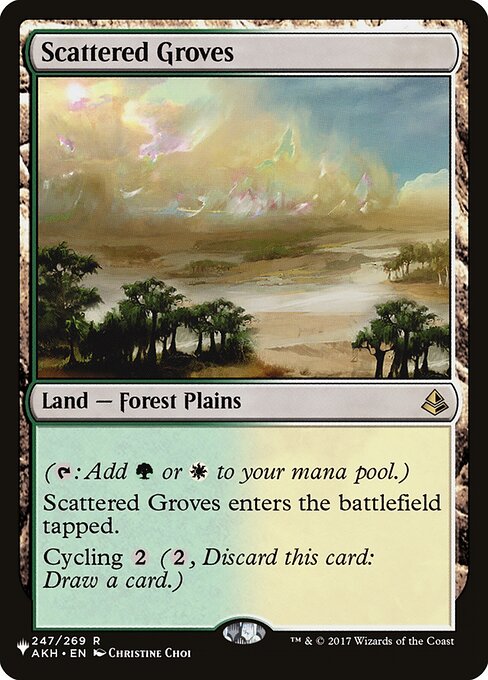
Can't afford dual lands? Tap lands are for you. Same concept as dual lands, but they enter the battlefield tapped, delaying their use by one turn (a real disadvantage in competitve Magic). There are many variations on this concept, as you can see. Some (Elfhame Palace, Tranquil Expanse) are functional reprints of each other—identical in every way except name. Others (Radiant Grove, Arctic Treeline) add "Forest Plains" to their subtypes, enabling you to 'fetch' them with certain cards (see my first land post). Some are snow lands, artifact lands, or gates. Some allow you to tap them the first turn they are in play, but then they do not untap the next turn, delaying the 'penalty' by one turn. There are other variations, too, but the same principle: you are getting a land that can produce more than one type of mana, but at a 'price:' tapping.


Conditional Tap Lands
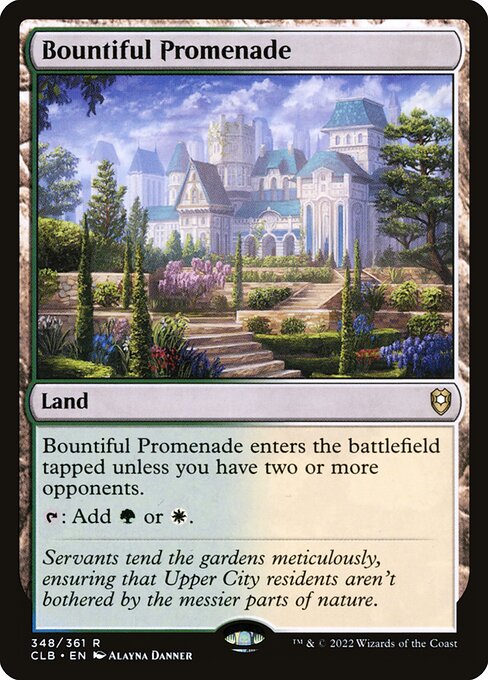
I made this term up; the article I mentioned above would call some of these "Battle," "Bond," or "Reveal" lands. Anyway . . . these lands are those that come into play tapped unless you meet conditions that enable them to come into play untapped. Consider Overgrown Farmland and Razorverge Thicket; these can be played untapped if you have two or more/fewer lands already in play.
Other conditions include number of opponents, number of basic lands you control, types of basic land you control, and types of basic lands you have in your hand.


Fetch Lands
These lands enable you to sacrifice them to find other land cards in your deck. Notice that some of them put the fetched land onto the battlefield tapped, and some do not. That can make a huge difference.


Pain & Shock Lands
Pain lands do damage to you whenever you tap them for colored mana. Shock lands, a type of 'conditional tap' land, do damage to you when you play them if you choose to play them untapped (otherwise, they come into play tapped). 

Bounce Lands
Lands that make you return another land you control to your hand to play them. They add two mana, though, and can be powerful in certain deck archetypes that benefit from lands hitting the battlefield (like landfall).


Deck Shaping Lands
I'm inventing (and combining) categories again; the article would call these "Cycle" and "Scry" lands. Some lands can be 'cycled' (discarded to draw a card). Some let you scry (look at the top card of your library and put it on the bottom if you wish). Whatever the case, these lands give you access to more desirable cards.


Gain Lands
These come into play tapped, but give you life.

Filter Lands
These let you add two mana (potentially of different colors) for the price of paying one. In the case of Wooded Bastion, you could pay (say) one white mana to add two green. And you could use a red mana and tap Sungrass Prairie to add one white and one green. Since these lands enable you to (effectively) change your mana's color, they are called filter lands.

Final Thoughts
Lands can be so expensive because they are the game's resources, and he who has the most powerful resources has an upper hand. Since many competitive Magic decks are (at least) two colors, getting lands that produce either color of mana is important. If you can afford those that do not tap the turn they come into play, even better. Due to their importance (and the sheer variety of cards in the game), nicknames for certain types of lands have arisen over the years.

Thursday, June 22, 2023

Balanced

Crop Rotation card art
Back on the land focus for the month (I've already covered their inherent nature and basic vs non-basic), today I look at how to determine how many (and which kinds) of lands to put in your deck. I'll use 60-card decks for example purposes, but the ratios discussed here can hold true for decks of any size, from 40-card limited to 100-card commander.

There are only two things you need to determine how much of your deck should be land cards: the land/non-land balance and the types of land.

The Land/Non-Land Balance
The general rule of thumb: your deck should be 40% lands. For a 60-card deck, that means 24 cards should be land cards. However, this is only a recommendation; a typical range is more like 18-30, for reasons I discuss below. Other types of decks (those that feature gimmicky cards like treasure hunt) may have 80% or more lands, but I will omit niche strategies from the discussion.

The number of lands depends on your deck strategy and mana curve. 
  • Aggressive decks typically have a lower mana curve (more low-cost spells) and fewer lands (18-22). The point with them is to hit hard and fast before your opponent can set up defenses; in that case, you need fewer lands (and want more spells) to increase the possibility of drawing playable cards early.
  • Control and midrange decks tend to run more in the 22-26 land range, with a typical mana curve. 
  • Stompy or landfall decks may hit 26-30 lands, as they have a higher mana curve (more high-cost spells) or require lands (in a landfall deck) to execute their strategy.
What's right for your deck? It depends. While impossible to be prescriptive for every scenario, if you have no idea what to do, I recommend you put 22 lands in an aggro deck, 24 in a control or midrange deck, and 26 in a stompy or landfall deck. If you're new to Magic or don't know how to classify the deck you have, run with 24 lands. 

The only way to verify the balance? Playtest your deck. A lot. Look for trends: do you have too many land cards in most games? Too few? Just right? This will tell you how you need to adjust the balance, if at all. The key here is trends: every deck has that game where you experience mana flood (too many lands) or mana screw (too few). But if you play 10 games and you have too few lands in 8 of them, you can bet that you need to re-balance your deck by adding a few land cards (or cards that let you fetch lands).

Of course, you can run fewer lands if you include spells that let you fetch lands (search for them in your deck).

Types of Land
In addition to land/non-land balance, multi-colored decks must consider the types of land to include. For mono-colored decks, this is easy. You can use just one type of basic land card and be done. For multi-colored decks, it gets trickier. We'll go with two colors (white/green) for example purposes.

Let's say you have a white/green deck, and decided on 24 lands. How many should produce white mana? Green? This comes down to your card selection on the non-land side. One easy way to do this is count the white mana symbols in all the non-land cards in your deck. Now count the green. Add those totals and figure out the percentage of white to green, then put in lands accordingly. If your 36 non-land cards have a total of 20 white mana symbols and 30 green, your land base should be 20/50=40% white and 30/50=60% green. Once that is determined, you have to figure out how to make that happen. There are a few options:
  • The easiest (but not necessarily best) way: use only basic lands. Put 10 plains and 14 forests in your deck and call it a day. This is easy (and cheap) but inflexible—for example, if you have all white cards in your hand but only green lands, you are out of luck.
  • You could use some dual-colored lands (those capable of producing white or green mana), like the two examples below. These give flexibility but often come into play tapped, slowing down your deck.

  • You could use fetch lands (lands that let you find the type you need), like Evolving Wilds (below). This is flexible but slow, too. Cards like this can be useful in 3- and 4-colored decks, giving you access to the type you need.

You can use the above strategies in any combination, using a mixture of basic, dual, and fetch lands into your deck. Most competitive players do just that.

Choosing the right balance (and types) of lands is part art, part science. The basics above are a starting point, but the ultimate answer comes through playtesting.

Sunday, June 18, 2023

When Worlds Collide

Tom Bombadil; never saw him in the LOTR movies!
I interrupt this month's "land" theme to reflect on the just-released Magic expansion, Tales of Middle Earth. This set brings the characters and events of the Lord of the Rings into the rules and mechanics of Magic: the Gathering. And when worlds collide, weird things are bound to happen.

The big challenge here is making this set feel authentically Lord of the Rings and authentically Magic: the Gathering. Magic's previous forays into licensed territory started with Dungeons & Dragons. That worked (I really enjoyed Adventures in the Forgotten Realms). They then released Warhammer commander decks, but I didn't collect those, so I cannot speak to them. For some reason, Lord of the Rings feels different. I think it's because this is the first widely-popular licensed property they are putting into Magic. D&D and Warhammer certainly have their niche audiences, but Lord of the Rings enjoys a popular appeal in the wider culture. It is important to get it right . . . but what does that look like? We'll look at three elements: characters, story, and the ring.

Characters
The Lord of the Rings characters are well-known and beloved by many. How do they 'map' to a Magic card? Each Magic color has strengths and an 'identity' associated with it, as I discuss here. Can characters from other 'worlds' map to this easily? Let's look at Gandalf the wizard as an example, who has several iterations in this set:

Since Gandalf is literally nicknamed 'the White' at one stage in the books, it makes sense to have his mono-white versions above. But then he has a mono-blue and a blue/red version, too. I could see those happening, though I'm surprised there isn't a white/blue version. I could make a case for green, too, based on his relationship with the creatures of Middle Earth. 

Other characters/creatures are similar. Some appear obvious (elves are green, dwarves are red), but even those can vary (several elves have blue in this set, due to their strengths in magic. I get it, but it seems a touch off). Goblins? Red, too. Makes sense, but does that mean they are allied with the dwarves? Of course not. 

At first glance, I don't think Wizards did a bad job there, but my point is that it is hard or impossible to map LOTR characters to Magic colors.

After color comes abilities. Same challenge here; how does one map LOTR characters to existing Magic keywords? Some will be intuitive; others impossible.

Story
They have been producing Lord of the Rings games for decades. A consistent challenge is capturing the 'feel' of the books, by which I mean the essence of the story.

While there are many battles in Lord of the Rings, the books are not focused on them. It is rather a hero's journey—a story about growth, friendship, and doing what must be done in the face of impossible odds. And a physical journey, too, visiting tons of locations. How do you capture that sort of thing in a game? It is difficult.

Previous games based on this franchise have varied in approach, but have some common elements.
Lord of the Rings TCG, Journey to Mordor, Journeys in Middle Earth, and Lord of the Rings: the Card Game all incorporate the idea of a journey into them by including different locations (or quests) as key game elements. That makes sense; locations in the books play a huge part in what's going on, and moving from one to the next brings a unique set of challenges for the fellowship. Magic doesn't have locations, per se, but lands that can highlight the locations. The lands in Tales of Middle Earth look great, but aren't locations to be visited, which detracts from the experience. Other locations (or parts of them) can show up as artifacts, like the Argonath:
Cool, but it doesn't capture the spirit of the story, in my opinion. 

As I reflect on this aspect, I think Magic should have incorporated a variant of Planechase elements into this release. Perhaps have a series of planes aligned to the books' progressions, with advancement triggered by conditions stated on them. That would have been cool.

The Ring
Finally, we'll look at the ring. Magic handles this in two ways. The first is with the ring itself:
As a mythic rare, this is a cool card, but not expected to feature in every deck. The loss of life for each burden does tie in nicely to the spirit of the novels. 

The second way is with the ring tempting you. Many cards say "the ring tempts you" as part of their effects. What does that mean? The rules inserts explain:
I'm not sure how I feel about this one. It is hard to discern, without playing, how it would feel in gameplay. It looks odd from the outside, but once this is released in Arena, I will play with it and update this post as necessary. 

Conclusion
Incorporating a popular universe into Magic is a tough task. At first glance, Wizards did a good job mapping LOTR characters into Magic's mechanics, but didn't capture the essence of the story as well as they could have. The verdict on the ring is still out. Though this set promises to sell well, and initial reviews indicates it plays well (as a Magic release), I don't know if they really captured the spirit of LOTR.