Sunday, May 29, 2022

Angelic

Radiant, Serra Archangel card art. Not in the deck but cool.
Some Magic decks construct themselves . . . at least, that's the way it seems. Sometimes Wizards releases a series of cards in standard that scream "build a deck out of me." In the current standard, the Angels tribe is made to shine. Here's the decklist I've been running:

4 Youthful Valkyrie (KHM) 382
4 Starnheim Aspirant (KHM) 380
4 Righteous Valkyrie (KHM) 24
4 Inspiring Overseer (SNC) 18
4 Giada, Font of Hope (SNC) 14
2 Valkyrie Harbinger (KHM) 374
4 Starnheim Unleashed (KHM) 33
2 Elspeth Resplendent (SNC) 11
2 Doomskar (KHM) 9
3 Beaming Defiance (STX) 9
2 Fateful Absence (MID) 18
2 Borrowed Time (MID) 6
23 Plains (JMP) 40

Kaldheim released five impressive angel spells. Streets of New Capenna added three more, forming the core of the deck:


I round it out with four removal or protection spells. Though I've played it only four times so far, a 75% win rate is quite nice. 

Thursday, May 26, 2022

Streets of New Capenna Sealed

With Streets of New Capenna's release, Arena ran a sealed event (my favorite format). I participated only once this time.

Sealed 1
Record: 4-3
This Esper deck worked better than I anticipated. After two quick losses, I thought it would be an early exit, but four consecutive wins were quite satisfying. Brokers Initiate was an effective late-game stud, as was Shattered Seraph. Queza was nice, too, a satisfying way to bleed an opponent slowly.

1 Security Bypass (SNC) 59
4 Plains (SNC) 263
1 Body Launderer (SNC) 68
4 Island (SNC) 265
1 Raffine's Tower (SNC) 254
2 Skybridge Towers (SNC) 256
1 Celestial Regulator (SNC) 174
6 Swamp (SNC) 267
2 Tainted Indulgence (SNC) 227
1 Obscura Charm (SNC) 208
3 Shattered Seraph (SNC) 221
1 Queza, Augur of Agonies (SNC) 212
1 Scuttling Butler (SNC) 244
1 Cut of the Profits (SNC) 72
1 Rogues' Gallery (SNC) 92
1 Incriminate (SNC) 84
1 Corrupt Court Official (SNC) 70
1 Boon of Safety (SNC) 4
1 Kill Shot (SNC) 19
1 Inspiring Overseer (SNC) 18
1 Witness Protection (SNC) 66
1 Make Disappear (SNC) 49
1 Crooked Custodian (SNC) 71
1 Expendable Lackey (SNC) 43
1 Brokers Initiate (SNC) 5

Saturday, May 21, 2022

Strength & Synergy

Nightpack Ambusher
My sons are back into playing Magic with me. As is typical, we go through seasons in life, and they played often 1-2 years ago but fell away as other hobbies piqued their interest. In recent weeks, they've rekindled the desire to play, and I've been enjoying that. It's fun to spend time with them, of course, and it's also a joy to see this game through their eyes. They understand a lot, but one concept they definitely don't get is synergy.

When my sons build a Magic deck, they include cards they view as strong, but pay little/no attention to synergy. (And, generally, 'strength' to them means a planeswalker or huge creature. Green is a preferred color.) And ignoring synergy is always to their detriment.

As I mention on my main page about decks
In Magic, you can win with any number of strategies, but every strategy needs a deck with synergy- your cards need to work together well to implement your chosen strategy. Together, they must be more than the sum of their individual abilities. 
Synergy is key. Almost any card in this game can be good or bad based entirely on the deck it is in (and the format you're playing). There are certainly some 'staple' cards- cards that will show up in many flavors of decks. These are generally 'generic' removal cards that all decks should include to some extent. But removal is only part of the game- it prevents or slows your opponents, but you need other cards- with synergy between them- to win. (And, ideally, even your removal cards can be chosen to synergize with your strategy.) So, how do you build with synergy in mind?

The first (and most important) step is deciding what you want your deck to do- how you want your deck to win. (I cover some basic strategies in the aforementioned deck article.) One approach is to pick a card you like and build a deck off of it. We'll do that today as an example. I'll use one of my childrens' favorites, Nightpack Ambusher.
Nightpack Ambusher is a cool card. It makes your (were)wolves stronger, and gives you a wolf token if you didn't cast any spells on your turn. It also has flash (it can be played any time you could play an instant), giving you the option of surprising an opponent on their turn. Lots of goodness here . . . how do we build off of it?

We could simply put Ambusher in a wolf deck, as it makes them all stronger, but let's fully use its capabilities. We don't want to be casting spells on our turn, so we get that nice wolf token. That means we want a lot of instants and/or cards that have the 'flash' keyword. Blue is the color of choice for instants, so I suggest a blue/green ("Simic") flash deck. Here is an example decklist:
4 Spectral Sailor (M20) 76
10 Island (IKO) 265
4 Brineborn Cutthroat (M20) 50
2 Sea-Dasher Octopus (IKO) 66
1 Pouncing Shoreshark (IKO) 64
1 Voracious Greatshark (IKO) 70
4 Wildborn Preserver (ELD) 182
10 Forest (IKO) 274
4 Nightpack Ambusher (M20) 185
4 Frilled Mystic (RNA) 174
2 Temple of Mystery (M20) 255
2 Breeding Pool (RNA) 246
3 Hydroid Krasis (RNA) 183
3 Opt (ELD) 59
2 Brazen Borrower (ELD) 39
4 Neutralize (IKO) 59

The lands are in italics. Creatures with flash are underlined. Instants are in bold. From here, only one non-land card- Hydroid Krasis- must be played on your turn. Everything else can be cast on an opponent's turn, enabling you to maximize Ambusher's ability. The deck's removal cards- Frilled Mystic, Neutralize, Brazen Borrower, Pouncing Shoreshark, and Voracious Greatshark- all play into this synergy. There is card draw (Opt, Spectral Sailor, Hydroid Krasis, Sea-Dasher Octopus), and Brineborn Cutthroat gets bigger every time you cast a spell on an opponent's turn:
In short, this deck plays to Nightpack Ambusher's strengths. It has synergy, removal, and card draw. Though it lacks thematic consistency (important to some but irrelevant to gameplay), it is an effective deck due to its synergy.

But what about other wolves? This deck doesn't make great use of Ambusher's "Wolves get +1/+1" ability. (It does for the wolf tokens created, of course, but couldn't we do more with that?) Of course, we can. We could have included cards like Ferocious Pup, which gives us two wolves, both of whom would benefit from Ambusher's plus-up:
And for certain decks, this card would make complete sense. But synergy is also about efficient synergy- meaning getting the most out of how cards interact- and in my view, playing this card in lieu of others in the deck above doesn't provide the same cost/benefit ratio. Yes, you get two wolves, but you must play it on your turn, meaning, Ambusher's "create a wolf token" ability wouldn't trigger. So in effect, this is netting you one wolf- a 0/1. Hardly worth three mana. It would be better to play nothing, get the wolf token for free, and cast something on your opponent's turn instead- either a creature with flash or an instant that could net you cards or counter spells.

Efficient synergy can be hard. It's all about tradeoffs and cost/benefit. But when you start thinking in these terms, it will improve your deck construction. In Magic, the game frequently goes to the synergistic- not to the strong.

Saturday, May 7, 2022

Buying Magic Cards

Catalog card art
I recently realized that I've never posted about where to buy Magic cards. Today's post is an overview.

While some basic Magic products (like booster packs, bundles, and some preconstructed decks) can be found at retailers like Walmart and Target, there are much better places to shop when you want to add to your collection:
  1. Your local game store.
    • This should be the obvious and first choice. Supporting your local game store is good for the community (and a great place to meet other Magic players). Most LGS offer sealed products for MSRP, though some have rewards programs that give discounts. Some LGS also sell singles.
  2. TCG Player or Cardmarket.eu.
    • Both sites feature a huge conglomeration of online vendors (from professional sellers to individuals), available in one web location for your convenience for both sealed products and singles. You choose the product(s) you want from the seller(s) you want and pay once for multiple shipments. If you're in America, TCG Player is your choice. If you're in Europe, Cardmarket. The latter is much cheaper.
  3. Other good online options.
    • The below sites offer singles and sealed products, some custom content (like unique tokens or pre-made starter decks for various audiences), bulk collections, rewards programs, and often buy single cards as well.
    • CoolStuffInc.
      • I've used CSI for almost twenty years now. Their customer service is outstanding and the rewards program is solid. Shipping times aren't what they used to be, but I've noticed that across the board.
    • TrollandToad.
      • Much like CSI.
    • CardKingdom.
      • Like CSI, but with higher prices and (I'm told) faster shipping.
    • MiniatureMarket.
      • Sealed products only. Good prices but slow shipping.
    • StarCityGames.
      • Much like CSI, I think.
I'd avoid buying cards on Amazon- I've heard reports of fake cards or tampered products.

There are other options, of course, but the above are 'verified' and dependable (though the conglomeration sites may have questionable sellers on them- check ratings or stick with powersellers to avoid disappointment).

Saturday, April 30, 2022

The Reserved List

Mystical Tutor card art
As you'd imagine, the Internet reacted to Elon Musk's Twitter takeover with a flurry of jokes. Here's one of them:
That list is the subject of today's post. 

The Reserved List was created in 1996 and updated twice (last in 2010). It features 572 cards from the Alpha (the first set) through Urza's Destiny (released in 1999) that will never be reprinted. (You can see the list on the official page.)

The Reserved List is different than banned or restricted cards- those cards that cannot be played at all (or include only one copy in a deck) depending on format. Though some Reserved List cards are also on the banned/restricted list, most are not, meaning one can have 4 copies in a deck (if the format in question permits that card's set). And they're not necessarily powerful or expensive- MTGStocks shows the value of Reserved List cards, and quite a few can be purchased for less than ten dollars.

So why the Reserved List? MTG Wiki says it best:
"The Reserved List is a list of Magic: The Gathering cards that will never be reprinted in order to preserve their value on the secondary market."
The official Wizards page talks the list on their reprint policy page. Basically, they're trying to strike a balance, for the same reason they rotate sets.
  • Reprinting cards enables new players to obtain staples or favorites. It can encourage participation and growth. But it also drives the price of those cards down.
  • Refusing to reprint [some] cards preserves value for the veteran players and collectors. It can encourage investment in the game. 
There is always a balance between including the new and honoring the old. Set rotation and The Reserved List are two ways to do that. Though I don't always agree with how Wizards produces Magic, I believe these two concepts are good ideas.

Monday, April 25, 2022

Creature Types and Prevalence

a fun card in any tribal deck
I've previously blogged about creature types and tribes in Magic. Today I look at the prevalence of types.

From the most recent (4/29/2022) comprehensive rules, the current creature types are:

205.3m Creatures and tribals share their lists of subtypes; these subtypes are called creature types. The creature types are Advisor, Aetherborn, Ally, Angel, Antelope, Ape, Archer, Archon, Army, Artificer, Assassin, Assembly-Worker, Atog, Aurochs, Avatar, Azra, Badger, Barbarian, Bard, Basilisk, Bat, Bear, Beast, Beeble, Beholder, Berserker, Bird, Blinkmoth, Boar, Bringer, Brushwagg, Camarid, Camel, Caribou, Carrier, Cat, Centaur, Cephalid, Chimera, Citizen, Cleric, Cockatrice, Construct, Coward, Crab, Crocodile, Cyclops, Dauthi, Demigod, Demon, Deserter, Devil, Dinosaur, Djinn, Dog, Dragon, Drake, Dreadnought, Drone, Druid, Dryad, Dwarf, Efreet, Egg, Elder, Eldrazi, Elemental, Elephant, Elf, Elk, Eye, Faerie, Ferret, Fish, Flagbearer, Fox, Fractal, Frog, Fungus, Gargoyle, Germ, Giant, Gnoll, Gnome, Goat, Goblin, God, Golem, Gorgon, Graveborn, Gremlin, Griffin, Hag, Halfling, Hamster, Harpy, Hellion, Hippo, Hippogriff, Homarid, Homunculus, Horror, Horse, Human, Hydra, Hyena, Illusion, Imp, Incarnation, Inkling, Insect, Jackal, Jellyfish, Juggernaut, Kavu, Kirin, Kithkin, Knight, Kobold, Kor, Kraken, Lamia, Lammasu, Leech, Leviathan, Lhurgoyf, Licid, Lizard, Manticore, Masticore, Mercenary, Merfolk, Metathran, Minion, Minotaur, Mole, Monger, Mongoose, Monk, Monkey, Moonfolk, Mouse, Mutant, Myr, Mystic, Naga, Nautilus, Nephilim, Nightmare, Nightstalker, Ninja, Noble, Noggle, Nomad, Nymph, Octopus, Ogre, Ooze, Orb, Orc, Orgg, Otter, Ouphe, Ox, Oyster, Pangolin, Peasant, Pegasus, Pentavite, Pest, Phelddagrif, Phoenix, Phyrexian, Pilot, Pincher, Pirate, Plant, Praetor, Prism, Processor, Rabbit, Raccoon, Ranger, Rat, Rebel, Reflection, Rhino, Rigger, Rogue, Sable, Salamander, Samurai, Sand, Saproling, Satyr, Scarecrow, Scion, Scorpion, Scout, Sculpture, Serf, Serpent, Servo, Shade, Shaman, Shapeshifter, Shark, Sheep, Siren, Skeleton, Slith, Sliver, Slug, Snake, Soldier, Soltari, Spawn, Specter, Spellshaper, Sphinx, Spider, Spike, Spirit, Splinter, Sponge, Squid, Squirrel, Starfish, Surrakar, Survivor, Tentacle, Tetravite, Thalakos, Thopter, Thrull, Tiefling, Treefolk, Trilobite, Triskelavite, Troll, Turtle, Unicorn, Vampire, Vedalken, Viashino, Volver, Wall, Warlock, Warrior, Weird, Werewolf, Whale, Wizard, Wolf, Wolverine, Wombat, Worm, Wraith, Wurm, Yeti, Zombie, and Zubera.

According to MTG Wiki, this adds up to 262 types of creatures. Whoa. But it's not as crazy as it sounds.

First, a creature can have more than one type. A Human Wizard is both Human and Wizard. 

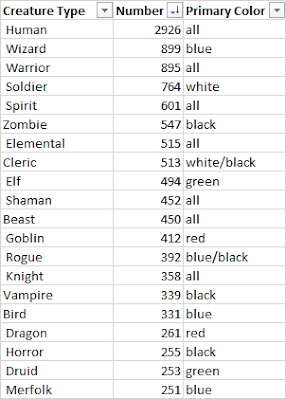
Second, as you'd expect, some tribes are far more prevalent (meaning far more creature cards of that type have been printed over the years). And many types (97, to be exact) are rarely seen, with 10 or fewer different ones of that type printed. In fact, 24 of that 97 had 0 cards printed- these are creature types that are tokens created by other creature types (example: see Nadir Kraken below. Its ability can create Tentacle creatures- a creature type that has yet to be printed as a stand-alone card).

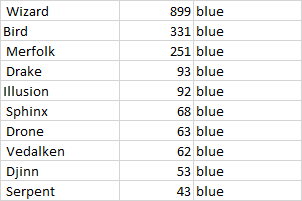
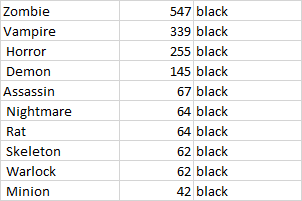
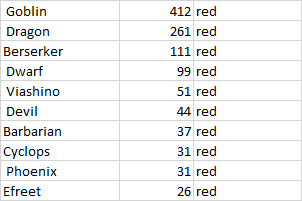
Here are the top 20 creature types, also showing number printed and primary color (found using Scryfall "type:___" searches):

The top ten for each color:


For a person like me who loves tribal decks, this data gives some insight into the sheer amount of options you have when constructing a deck with a particular tribe in mind.

Monday, April 11, 2022

Collecting on Arena

Collector Protector card art

Arena is a great way to enjoy Magic, especially in the pandemic. There's a program called 'untapped.gg' that helps keep track of your records, decks, and collection. Today's post focuses on the last.

There are several ways to collect a set on Arena:
- use the gold you earn from daily wins & challenges to 'buy' digital packs. 
- acquire packs as you pass certain thresholds and 'level up' on the mastery track.
- convert wildcards (earned from opening packs and leveling up on the mastery track) to cards from the set.
- buy a mastery pass ($20 in real money or 3400 gems in the game) to level up on the mastery track much faster and earn more packs for a given set.

How much of a set can you collect using this method? I tried this for the Crimson Vow set, buying a mastery pass and using the other three methods described above, and tracked how much of my collection increased.

Example using Crimson Vow
In Crimson Vow, you can collect 1068 total cards (4 copies of 267 cards).* 

I opened 126 total packs: 120 packs (opening 10 at a time) plus 6 packs from two drafts. Here is how my collection increased by percentage:

7-7-7-7-7-5 (6 packs through two drafts)-5-5-3-4-3-3-2

To explain: the first 10 packs I opened gave me 7% of Crimson Vow (75 cards). The next 10 packs gave me an addition 7%. That trend continued through the first 50 packs, giving me 35% of the set. I then did two drafts, opening six packs and netting me another 5%. I then opened a sequence of 10 more packs, earning 5%, 5%, 3%, 4%, and so on as shown above. As you'd suspect, the percentages started to decrease as I collected more, as I started getting cards above the 4 maximum copies permitted in a collection. Those extra cards are either wasted or converted to wildcards. 

From the above, opening 126 packs gave me 65% (694/1068) of the set. But I acquired a lot of wildcards, and I converted a chunk of them to cards I wanted. The brought up my total. The end result: 126 packs plus wildcard conversion gave me 72.9% (779/1068 cards) of Crimson Vow.

By rarity:
Common: 98% (394/400)
Uncommon: 67% (224/332)
Rare: 50% (128/256)
Mythic: 41% (33/80)

Current Standard
The above example was for Crimson Vow. What about other sets in standard? I've purchased a mastery pass for many, but not all, sets in the current standard. As mentioned, doing so accelerates leveling and pack acquisition. And the results are obvious: in the current seven sets in standard, I have much less of Strixhaven and Kamigawa, the two sets for which I did not buy a mastery pass:
- Zendikar Rising: 87.9% (932/1060)
- Kaldheim: 80.9% (890/1100)
- Strixhaven: 58.4% (643/1100)
- Adventures in the Forgotten Realms: 76.2% (796/1044)
- Midnight Hunt: 75.5% (807/1068)
- Crimson Vow: 72.9% (779/1068)
- Kamigawa: Neon Dynasty: 26.3% (297/1128)

I did not gather statistics on how many packs I bought of each set above, but you can see the general trend: buying a mastery pass gives you 15-20% more of a set.

Concluding Thoughts
It is much cheaper to acquire cards on Arena. Spending $20 and ending up with 75% of a set is something you could never do for physical cards. Or spending nothing and getting 50%+ of a set is equally impressive. It's a great way to explore the game without paying top dollar.


*untapped.gg doesn't count the 10 basic lands. Wizards shows Crimson Vow as having 277 cards for this reason.