Showing posts with label formats. Show all posts

Sunday, March 22, 2026

Commander Variants

Barrins Codex Card Art
Magic has many formats—and ways to tweak them. Commander is one of the most popular formats, and today I look at two variants of it: Pauper and Peasant Commander.

"Pauper" and "Peasant" are terms used in Magic when players restrict the eligible card pool in a given format to cards printed at common (pauper) or uncommon (peasant) rarity. The goals are to 1) make it more affordable/accessible, and 2) force players to explore options by playing less powerful cards they would otherwise ignore. 

In regular Commander, you have:
- 1 legendary creature (any rarity) that is your Commander and sets the color identity for the deck
- 99 other cards (any rarities)
- 40 life

For peasant and pauper variants, there are no official rules so variations on the below exist, but I present common options here:

- 1 legendary creature (any rarity) that is your Commander and sets the color identity for the deck
- 99 other cards (up to 15 uncommons; the rest commons)
- start with 40 life

- 1 legendary creature (common or uncommon only) that is your Commander and sets the color identity for the deck
- 99 other cards (commons only)
- start with 30 life

I've blended the two to make my own variant (let's call it "Yeoman" Commander):
- 1 legendary creature (uncommon only) that is your Commander and sets the color identity for the deck
- 99 other cards (uncommons or commons only; no limit to uncommons)
- start with 40 life

A note on rarity: any card that was every printed at uncommon or common can be considered. Rarity shifts happen in Magic, so what is now (or once was) a rare may have changed.

My recent mission has been making two-color Yeoman Commander decks in all 10 color combinations. Restricting the card pool to commons and uncommons has been a fun experience. Here are the eligible commanders for each color combo, with numbers afterwards showing the current options as of this writing:
- WU (23)
- UB (30)
- BR (29)
- RG (27)
- WB (20)
- WR (23)
- WG (28)
- UR (20)
- UG (19)
- BG (18)

Check out this (and other) format variations—or dream up your own. Tweaking the game, even mildly, can have some unexpected and fun results.

Wednesday, March 18, 2026

Commander Brackets

How do you describe the potency (or power level) of a Magic Commander deck? And why does it matter? This post looks at this concept as defined by Wizards in the last few years.

Ever feel like you're out of your league? That you're competing against players who are fielding decks much stronger (or weaker) than yours? This game is most enjoyable when you compete against people on a level playing field (that's one reason draft and sealed formats are so much fun). Playing in Standard can require shelling out lots of cash to have the most competitive [and thus expensive] decks, and the problem only worsens with Commander (because it has a much wider card pool, meaning even more expensive cards can be needed to be competitive). What's one to do? Wizards is attempting to solve this problem through Commander Brackets.

Commander brackets is a five-tier system (see above illustration) to group decks according to their perceived power level. Wizards announced the concept in February 2025 and gave an update in October. From the latter article, it summarizes the brackets as follows:
  • Bracket 1: Exhibition
    • Players expect: Decks to prioritize a goal, theme, or idea over power
    • Win conditions to be highly thematic or substandard
    • Gameplay to be an opportunity to show off your creations
    • You should expect to be able to play at least nine turns before you win or lose
  • Bracket 2: Core
    • Players expect: Decks to be unoptimized and straightforward, with some cards chosen to maximize creativity and/or entertainment
    • Win conditions to be incremental, telegraphed on the board, and disruptable
    • Gameplay to be low pressure with an emphasis on social interaction
    • Gameplay to be proactive and considerate, letting each deck showcase its plan
    • You should expect to be able to play at least eight turns before you win or lose.
  • Bracket 3: Upgraded
    • Players expect: Decks to be powered up with strong synergy and high card quality; they can effectively disrupt opponents
    • Game Changers that are likely to be value engines and game-ending spells
    • Win conditions that can be deployed in one big turn from hand, usually because of steadily accrued resources
    • Gameplay to feature many proactive and reactive plays
    • You should expect to be able to play at least six turns before you win or lose.
  • Bracket 4: Optimized
    • Players expect: Decks not to adhere to the cEDH metagame reserved for Bracket 5
    • Decks to be lethal, consistent, and fast, designed to take people down as fast as possible
    • Game Changers that are likely to be fast mana, snowballing resource engines, free disruption, and tutors
    • Win conditions to vary but be efficient and instantaneous
    • Gameplay to be explosive and powerful, featuring huge threats and efficient disruption to match
    • You should expect to be able to play at least four turns before you win or lose.
  • Bracket 5: cEDH
    • Players expect:Decks that are meticulously designed to battle in the cEDH metagame, with the ability to win quickly or generate overwhelming resources; often built using existing cEDH knowledge, tools, and/or decklists
    • Win conditions to be optimized for efficiency and consistency
    • Gameplay to be intricate and advanced, with razor-thin margins for error; players prioritize victory over all else
    • These games could end on any turn.
The latter article linked above explains more about "Game Changers" and lists the 51 cards there.

This is a great concept. Though judgment is always involved, having a tier system like this enables players to self-score their decks and find a playgroup running at that level. I look forward to seeing how this evolves.

This system also reveals what designers feel makes the game powerful. Study the image above. You'll see things like land denial, extra turns, 2-card infinite combos, game changers, and tutors [cards that let you search your deck for a card and put it into your hand]. Those aspects, apparently, are what set decks apart from each other.

Looks like most of my decks are Bracket 1 and 2 . . . I might dabble in Bracket 3, but I've never won a Commander game in six turns. 

Until next time . . . keep exploring.

Sunday, March 15, 2026

Teenage Mutant Ninja Turtles: Turtle Team-Up

Today, I look at another way to play Magic: a new cooperative format called Teenage Mutant Ninja Turtles: Turtle Team-Up. For 2-4 players, it takes 40 minutes or more.

Overview
Shredder, Krang, and other baddies are determined to take down the turtles and rule New York. Can you and your friends team up to stop them?

Turtle Team-Up is a cooperative form of Magic
- Each of you (2-4 players) has a preconstructed deck of 60 cards, each of which is based on a different turtle. Your team starts with a shared pool of life (20 for 2 players, 30 for 3, 40 for 4).
- Your 'opponent' is a series of Boss and Event cards. There are three stages of Bosses to overcome. 
- For each boss stage, your opponent starts with 20 life. Reduce them to zero to overcome that boss and move to the next. The first stage has one boss, the second two, and the third three. 
- Bosses are like enchantments: they have some effect that is true so long as they are on the battlefield. Once you get a boss stage to zero life, all bosses in that stage are discarded.

Turns:
On your turn, like regular Magic, you will draw a card and follow normal turn structure—except that you are all playing your turns simultaneously. Your opponent has no creatures who can block, so any attacks you launch will help you reduce your opponent's life.

On your opponent's turn, they draw a series of event cards (1-3, depending on the number of players) and resolve their effects. Event cards can be creatures (that cannot block) or effects (like "destroy all creatures"). Creatures on your opponent's side must attack if they can (following normal rules). One player chooses who they attack. You can choose to block them or let them decrement your life total . . . but sometimes that has other bad effects (depending on the boss(es) in play at the time).

Other game contents:
Tokens and four booster packs. After playing a few games with the preconstructed decks, use the boosters to strengthen your decks and improve your odds.

See the official site for more information (decklists, contents, etc.).

Review
My boys and I enjoyed this format. Cooperative games are always fun, and I like the "one vs. many" concept. That said, this product feels like 'boom or bust': you either win handedly or get destroyed. The Event cards feature enough board wipes or similar effects to make victory difficult—if they come out late in the game. (They are not spells that can be countered.) But if you get them early, before you have good board presence, you may be able to weather the storm. 

This is the first Magic product I've purchased where I found the rulebook lacking. Normally they do a good job of concisely explaining the rules, but this time, I had to fill in the gaps with my experience and hope I was interpreting things correctly.

Having the opponent's creatures unable to block diminishes some of the interaction, but is understandable for gameplay. In hindsight, I wonder if it wouldn't have been more fun to have one player control the bad guys and alter the card abilities to spice things up. Overall, though, this is fun.

Rating: B+

Friday, March 6, 2026

Ravnica: Clue Edition

Today I look at a different way to play Magic. It's time to explore Ravnica: Clue Edition. For 3-4 players, it takes 40-90 minutes.

Overview
Remember the board game Clue? Do you know Magic: Jumpstart? This game basically mixes the two.
- As in Clue, your goal is to figure out "whodunnit" by correctly guessing the suspect, room, and weapon that was secretly chosen and placed in the case file at the game's start. There are 21 cards (6 suspects, 10 locations, and 5 weapons). Examples:
image from here
- As in Jumpstart, you will open two 20-card themed packs (eight are included in the box; each is a two-color theme aligned to Ravnica guilds), shuffle them together to make your deck, set your life counter to 20, and play a normal game of Magic.

You can win one of two ways:
1) you reduce all opponents' life to zero (as in normal Magic)
2) you correctly guess the person, room, and weapon

For the second, your opponents each hold some people, rooms, and weapons (they were dealt randomly at the game's start). On a turn when you do damage to your opponent, you make guess one of each, and if that opponent has one of the guessed cards, they must reveal it to you. That opponent then creates a clue token (which can help them draw cards).

Review
I enjoyed this variation of Magic. Its fun that the 21 "Clue" cards are actual Magic cards (I've since built a Commander deck with one). Jumpstart is a great concept, too, so that is satisfying. And they did a good job of mixing reprints from Ravnica sets with brand new cards.

Here's what I did not enjoy: this comes with eight randomized boosters (there are 20 possible, two for each guild; see the official page for all of them). It is possible to get more than one copy of the same pack, and since there are ten Ravnica guilds (which equate to color combinations), there is no possible way you can get all ten guilds in one box. You must buy two (or more, if your luck is poor) to collect at least one of each guild, and purchase more still to have any hope of getting all 20 possible packs. Does that matter for gameplay? No. Would it have been nice to include ten boosters, for one of each guild? Yes.

The price was another downer; initially listed at $80, it wasn't worth near that, even with the included randomized shock land (I picked up one for $50, when they went on clearance).

Overall, this is a decent product that could have been great.

Rating: B

Wednesday, November 6, 2024

State of MTG Arena, 2024


A few days ago, Wizards released two articles on the state of their free online platform, MTG Arena. Here they are:
They are both worth a read; below, I unpack the most important (or intriguing) elements of each.

State of the Game
On Arena this year, they are on pace to release
  • 5 Standard set releases
  • 2 Nonrotating releases
  • 1 Classic release
  • 4 Alchemy releases
  • 1 Jumpstart release
That is over 3000 new cards. In one year. That is a lot to absorb. The rest of the article talks about various offerings (like preconstructed decks) or what is coming in 2025 (generically; no specific sets are listed).

State of the Formats
The below chart is copied from the article and shows the popularity of each format available on Arena.
  • Standard is a rotating format including the most recent sets.
  • Historic is "MTG Arena’s largest Constructed format, filled with both old and new Magic cards. Digital-only cards are legal in this format, including rebalanced versions of existing cards."
  • Brawl is similar to Commander: 100-card decks, single copies only
  • Alchemy adjusts Standard releases; the "cards feature mechanics designed for play only in Alchemy and Historic formats."
  • Explorer is "all cards legal in the Pioneer format that appear on Arena."
  • Timeless is "MTG Arena’s largest Constructed format where every card is legal. It includes the most powerful cards throughout Magic history."
Interesting how two formats—Historic and Timeless—are billed as Arena's largest Constructed format.

Chart aside, this paragraph bears quoting as showing the goal (and challenge) of each format:
In general, we want every format to be balanced, diverse, and fun. Balance is important so that you always feel like you have a fair shot at winning and that your decisions throughout a match matter. Diversity means both facing a wider range of opponents, which is refreshing, but also that you have a large number of viable decks and archetypes to play yourself. And fun is always vital. After all, any given player is going to lose about half of the games they play, so we want to make sure the play in each match is interesting and enjoyable.
They do a good job with these areas, even if it seems overwhelming.

Friday, September 8, 2023

Farewell, Commander

Inspiring Commander card art
I hadn't intended to do another farewell post this month, but a tragic event made me pivot: Shedon Menery passed away. He was well-known in Magic circles, but even if you don't know the name, you'll recognize his contribution to the Magic community: he came up with the Commander format, which some consider the most popular format in the game. RIP, Shedon.

As I briefly mention on my formats page, Commander's singleton rule (decks can contain only 1 copy of any unique card, except for basic lands) transformed the game. It didn't diminish the original Magic format/experience—it gave the game a fun new area to explore, using the entire Magic card base (vs. the rotating sets of Standard) and keeping things casual. One of the things I love about this game is just how flexible it is; Menery's creation was seminal in proving that.

I also enjoy how Commander came to be. Its original name was "Elder Dragon Highlander," or EDH, and it began as a grassroots effort in local game stores. This was not a Wizards employee pitching an idea to the company; it was players exploring the game's possibilities and developing something that became so popular the company recognized it and made it official (in 2011). In the ensuing years, Wizards has released preconstructed Commander decks, sets geared towards Commander drafts, and other products centered around this format. Impressive.

A final note: even the Commander format has spawned an 'internal' variant. The original Commander format is designed to be casual: players can strive to build synergistic decks, but there is a greater focus on social interaction and enjoying the odd or unexpected situations that come with playing singleton across a huge card pool. It is a chance to play those 'janky' cards that wouldn't see play in competitive environments. Competitive EDH (cEDH) is a spinoff. It has all the same rules, but the goal is to win as quickly as possible. To make a powerhouse deck that can win in just a few turns. TCGPlayer and TheGamer have good introductions to that concept; the former points out that it "is regular Commander with a different social contract," while the latter states that "the decks are built to be as powerful as they can be." I'll look more at those concepts—social contracts and power levels—another time. For today, we mourn Mr. Menery's passing but celebrate his contributions.

Saturday, September 2, 2023

Farewell, . . . nothing?!

Aquatic Alchemist card art
Each year that I have maintained this blog, September is dedicated to the four sets rotating out of Standard. I look at the cards I liked, the ones I didn't, and the sets as a whole. (Here is my first post on the subject, and another which explains the Standard format and set rotation.) So, first up this month is: 

nothing.

That's right, no sets are rotating out of Standard this year. Wizards announced in May that they were changing Standard rotation to every three years. Why? They explain in the article; I present the highlights below.

- tabletop Standard is key to local game stores
- this format (again, on tabletop—in person vs. online) hasn't kept pace with other Magic formats
- shifting to a 3-year rotation cycle does the following (italics is quoted from the article):
  • This will give current Standard cards more longevity. 
  • It will allow mechanics and archetypes to be more effectively built on over time. As we moved away from the block model, we gained a lot of flexibility, but we also lost some ability to build on mechanics and themes within a set. With a longer window, we can find more opportunities to build up or revitalize archetypes. 
  • It also gives us stronger tools to create an environment where decks are more "color(s) and mechanic" (like Green-White Toxic or Blue-White Soldiers) and less midrange. 
In the end, "we believe this will give Standard more stability, more vitality, and strengthen it for local game stores." Time will tell if this is the case.

I have no strong feelings one way or the other about this change. On the one hand, I get it. Based on release dates, some sets enjoyed only 15 months in Standard, which seemed too short (and unfair compared to the sets that were in for all 24). On the other hand, a card pool of such large size (and duration) might overwhelm players and/or dissuade new ones from jumping in. 

One comment intrigues me: Wizards wants "more 'color(s) and mechanic' (like Green-White Toxic or Blue-White Soldiers) and less midrange." From my decks page, midrange is a deck type that uses efficient spells. It can potentially take on both aggro, control, and combo decks. I am guessing that Wizards is saying "we want decks with a theme, not just a collection of efficient cards that can win games without synergy." I'd love to learn more about that.

Whatever you think about this change, it will be fun to enjoy the cards for longer.

Saturday, January 14, 2023

Color Identity

Catalog card art
Commander is perhaps the most popular format in Magic. Key to building a deck for this format is the concept of color identity.

  • 903.1. In the Commander variant, each deck is led by a legendary creature designated as that deck’s commander. The Commander variant was created and popularized by fans; an independent rules committee maintains additional resources at MTGCommander.net.
  • 903.4. The Commander variant uses color identity to determine what cards can be in a deck with a certain commander. The color identity of a card is the color or colors of any mana symbols in that card’s mana cost or rules text, plus any colors defined by its characteristic-defining abilities (see rule 604.3) or color indicator (see rule 204).
    • 903.4d The back face of a double-faced card (see rule 712) is included when determining a card’s color identity. This is an exception to rule 712.4a.
Those rules reference MTGCommander.net, which has similar verbiage on its rules page:

Deck Construction Rules
  1. Players choose a legendary creature as the commander for their deck.
  2. A card’s color identity is its color plus the color of any mana symbols in the card’s rules text. A card’s color identity is established before the game begins, and cannot be changed by game effects. The cards in a deck may not have any colors in their color identity which are not in the color identity of the deck’s commander.
  3. A Commander deck must contain exactly 100 cards, including the commander. If you’re playing a companion, it must adhere to color identity and singleton rules. While it is not part of the deck, it is effectively a 101st card.
  4. With the exception of basic lands, no two cards in the deck may have the same English name. Some cards (e.g. Relentless Rats) may have rules text that overrides this restriction.
I prefer the latter's wording on color identity. "A card’s color identity is its color plus the color of any mana symbols in the card’s rules text." Your Commander deck can include only cards that map to your Commander's colors. So if your Commander's color identity is white, you may include only cards that are white in your deck. If you Commander's color identity is blue and black, you may include cards that are blue, black, or blue/black in your deck. And so on.

Most of the time, a card's color identity is immediately evident by its casting cost. But per the above definition, you must also look at the mana symbols in the card's rules text. Consider Shalai, Voice of Plenty:
Her casting cost includes only the white mana symbol, but her rules text includes green mana, so her color identity is white/green. 
  • If she is your Commander, you could include white, green, white/green, or colorless cards in your Commander deck. 
  • If she is not your Commander but you want to include her in your deck, you must ensure the Commander you choose includes (at minimum) white and green in its color identity for Shalai to be eligible for inclusion (so I cannot use her in my mono-white angel Commander deck).

Rule 903.4d above mentions double-faced cards, which can be confusing.
  • 712.1. A double-faced card has a Magic card face on each side rather than a Magic card face on one side and a Magic card back on the other. There are two kinds of double-faced cards. Transforming double-faced cards include abilities on one or both of their faces that allow the card to either “transform” or “convert” (turn over to its other face) and/or allow the card to be cast or enter the battlefield “transformed” or “converted” (with its back face up). Modal double-faced cards have two faces that are independent from one another, and they can’t transform or convert.
Consider Brutal Cathar, a transforming double-faced card:
Brutal Cathar's color identity is white/red. Its front face is white, but when it transforms, its back face is red.

The modal double-faced cards are the most confusing. The same rules apply (the color identity is both sides combined) but are (to me) less intuitive, as these are effectively two Magic cards, and you choose which one you will use upon casting it. It cannot change or transform to the other side once on the battlefield. Consider Jorn, God of Winter:
If you cast Jorn as a creature, he is green. If you cast the other side (Kaldring, the Rimestaff), it is blue/black. The card cannot flip back and forth once on the battlefield. However, based on the rules, this card's color identity is blue/black/green, so it can be included in a Commander deck only if the Commander's color identity matches or exceeds those colors.

Finally, any Commander deck may include colorless cards—generally (but not exclusively) artifacts.
  • 105.1. There are five colors in the Magic game: white, blue, black, red, and green.
  • 105.2. An object can be one or more of the five colors, or it can be no color at all. An object is the color or colors of the mana symbols in its mana cost, regardless of the color of its frame. An object’s color or colors may also be defined by a color indicator or a characteristic-defining ability. See rule 202.2.
    • 105.2c A colorless object has no color.
The key here is Rule 105.2c. Since colorless objects have no colors, they may be included in any Commander decks. But again, they must be truly colorless, so check the rules text, too. Consider Bosh, Iron Golem:
His casting cost is generic (colorless for our purposes), but his rules text include a red mana symbol, so his color identity is red.

To date, there are over 1600 legendary creatures from which to choose your Commander. Choose wisely, and consider color identity when so doing. When building commander decks, you can use the 'commander' command in Scryfall to help identify cards eligible for inclusion. For example,
Returns cards whose color identity <=green/red. This returns green, red, green/red, and colorless cards. If you want to focus only on green/red, use:
And if you want to find a red/green commander, add 
From this, we see that there are currently 65 legendary creatures whose color identity is red/green. These are your pool of commanders if you want to build a Commander deck in exactly those colors.

Wednesday, October 19, 2022

Formats and Gentrification

Bestial Fury card art
One of Magic's cool features is how it can be tweaked to produce a new experience. As I explain on the main format page, one way to do this is to changing the eligible card pool for deck construction. This post looks at how formats drive up card prices.

Card prices in Magic are due to supply and demand, which in this game is a combination of rarity, scarcity, and popularity.
- Rarity: common, uncommon, rare, and mythic. The supply is generally lower as you progress.
- Scarcity: older sets (and some special releases today) don't have large print runs, producing very limited supply in some cases. Even 'bad' cards can be expensive if they're so scarce.
- Popularity: in today's world, there are myriad sites that track the successful decks in tournaments around the world. Consistently successful ones are generally expensive (or become so) as players start to pursue these highly sought-after cards and mimic those successful decks.

While the first two categories are static, a card's popularity can vary widely based on format, which in turn can drive card prices. Some examples:
- Standard is a very common format, featuring cards from the last handful of sets. As a rotating format, cards that rotate out can see nice price drops, as they are no longer eligible for inclusion in Standard decks.
- Pioneer and Modern are non-rotating formats that always grow (as new sets come out) but do not rotate, so a card popular in that format will likely be expensive and remain so until/unless the deck it supports falls out of favor (generally by being supplanted by a better deck).
- Commander decks are fun because they are a singleton format (you may include only one copy of each card) and multiplayer (meaning games can last much longer). It is much easier to obtain one copy of an expensive card than four. Hopefully.
- Pauper decks contain only cards that have (at some point) been printed at the common rarity. The appeal of that format is affordability- because they're commons, right? It was once affordable, anyway . . . 

So here's my beef. When a new format comes out, one goal of that format is often accessibility- enabling new or budget players to jump in and be competitive. Cards that were not in competitive decks in previous formats (and thus affordable) may have a prominent place in the new landscape. But then . . . that new format coaelesces around a pool of successful decks. Everyone then wants the cards in those decks, which in turn drives up the prices of those cards. Effectively, what we have here is gentrification.

Gentrification is, based on the Google/Oxford definition, where the character of something is changed by a richer population coming in, who then displace the current crowd. In Magic, this happens in every single format. Even Pauper costs can get pretty bad. Consider the average competitive deck cost, taken from cardboardkeeper.com and based on analysis from MTGGoldfish.com:
Magic The Gathering FormatAverage Competitive Deck Cost (2021)
Pauper$46
Standard$247
Modern$865
Commander$972
Legacy$4,033
Vintage$44,546
Now I would expect Legacy and Vintage decks to be insane- the cards in those are only from older sets that are so scarce it is nigh impossible for non-millionaires (or those who didn't collect the cards upon release 30 years ago) to enjoy that format. But almost $1000 for a competitive Commander deck, with Modern costs not far behind? And- the big one that bugs me- is Pauper. Sure, it is the cheapest at $46. You would expect it to be. But . . . $46 for a deck of just common cards, that (upon release) were likely pennies each? This all points to the reality of gentrification in Magic. We might see a new format in the future, which alters the card pool and enables use of overlooked gems, but we will end up in the same boat. If you want to be competitive, Magic is for those who are pretty well off. Or insanely so.

The best and obvious way around this all is to not play competitively (or play limited format only, where you do not rely on purchasing single chase cards). Casual is best. Enjoy this game with your friends. It is all about gathering . . . it's right there in the name.

Wednesday, August 31, 2022

Kingdom Magic

Roles for one version of this variation, from MTGSalvation

I meant to post this on 31 August, but I forgot. So I'm doing it now and retroactively putting that date on it, satisfying my self-imposed obsession to post 4 times per month.

Today's thoughts are on another Magic format- Kingdom Magic. Per this website, this format is like Commander Magic (100-card decks, start with 40 life, singleton) except:
- it is for exactly 5 players
- each player has a role with a corresponding win condition:
  • King: the only role known to others at the start. Goes first, starts with 50 life, and wins by surviving.
  • Knight: wins if the king is alive at the end (doesn't matter if the knight is alive according to some sources, though others say he must survive too).
  • Bandit 1: win if the king dies and they are alive at the end.
  • Bandit 2: win if the king dies and they are alive at the end.
  • Assassin: win if everyone else is dead.
I've seen different names for this format (like here)- called 'Bang EDH,' with different names for the above roles, but the same concept in principle. And here is yet another variation, with some more nuances/rules to the above roles.

The variations mentioned tell me that this format is unregulated and casual. I've never played it, but it sounds like a lot of fun- effectively adding a 'hidden role' game twist to Magic. I hope to check it out soon.

Sunday, July 31, 2022

Planechase

It's been awhile since I looked at different Magic formats (I should call them variants) . . . up today is Planechase.

In Planechase, each player brings a 60-card deck following normal construction rules (4 copies max of any non-basic-land card). The card pool can be whatever the players agree- standard, modern, casual, etc. Starting life is the same, too. The only difference: each player also has a 10-card 'planar' deck. Each card in that must be unique. These oversized cards represent planes featured throughout the years in Magic, and have an ability that affects all players (basically an enchantment) as well as a benefit if you roll the chaos symbol on the die (more on that in a moment). Example planar cards:

To start the game, the first player takes their top card of their planar deck and places it in the command zone. It affects all players. On a player's turn, they can (as a sorcery) roll the planar die, paying one generic mana more each time if they choose to try more than once. The result dictates what happens:
- Four sides are blank; no effect.
- One side has a planeswalker symbol. Roll that and the current plane is replaced by the topmost plane on the active player's planar deck (the replaced card goes to the bottom of its owner's planar deck)
- One side has a chaos symbol. Roll that and the chaos effect, printed on each planar card, triggers.
the planeswalker and chaos symbols
Planechase planar cards were originally released (four decks built for the format came with 10 planar cards each) in 2009. A follow-up, with new decks and planar cards, was published in 2012, and releases concluded with Planechase Anthology in 2016, which also came with four decks, but now 86 planar cards (some of which were 'phenomenon'- same concept, just different name), and the die.

It has been years since I played this variant, but I really enjoyed it. The planar cards add some craziness to the game, and their universal effects can result in hilarious situations. I picked up the set of 86 cards + die back in 2017, I think- then, it was very cheap to get those and forego the decks they came with (I think I paid $20). Today, just the set of planar cards will set you back $150, and that number at least doubles if you want the accompanying decks. So find a friend who has this and try it out if you can. Or write to Wizards and ask them to release it again. It's a fun experience.

Saturday, March 26, 2022

Vanguard


Continuing to look at different Magic formats, today I look at Vanguard- a format released in 1997-99.

Vanguard is like regular Magic save for one thing: each player plays as a hero, called a 'Vanguard'- represented by an oversized card featuring a hero from Magic's lore. This card:
  • modifies your starting/maximum hand size and starting life total
  • grants you some benefit
  • is not part of the game (and so cannot be affected by spells/etc.)
Two examples:

With Gerrard, your starting life remains 20, but your hand size (starting & max) is only 3 (vs. the typical 7). But what a benefit: you get to draw an additional card each turn.
With Ertai, your starting life is 24, your hand size (starting & max) is 6, and your creatures have hexproof (using the modern keyword for her stated ability).

Does the concept sound familiar? It should- it's reminiscent of Commander. Though the latter doesn't give you any starting hand size or life total benefit (or detriment), and affects how your deck is constructed (in terms of permitted colors to include), it could give you some powerful benefit (but generally only if it's on the battlefield). And a Commander can be affected by spells and effects. So there are clear differences, but the core concept of picking a hero to lead you is the same.

Vanguard was released in four sets of 8 heroes each. See the official site for a full list

I've never played Vanguard. I would love to, but since this is so old, finding these is difficult (read: expensive). I've heard that some Vanguard cards or concepts have come up in recent years (see this article and Ral's Vanguard), but it would be cool to see a release focus on this.

Sunday, March 6, 2022

Pauper

Sage of Lat-Nam Card Art

Continuing (from this January post) to look at different Magic formats, today I look at pauper.

Magic can get expensive. What about those players who enjoy the game but don't want to spend a crazy amount of money? Enter the pauper format. 

Pauper is just like 'normal' Magic (60-card decks, no more than 4 copies of a given non-basic-land card, and 20 starting life) except for one thing: the cards in your deck must have been printed at a common rarity at some point in Magic's history (any point- this is an eternal format; sets never rotate in or out). This is an official format; Wizards has a banned list for pauper cards deemed too powerful in this format.

Pauper decks are cheaper to buy and less powerful. Dialing down the speed and effectiveness of decks can be a boon to those overwhelmed by (and/or unable to compete with) the popular decks in other formats like vintage, modern, or standard. Pauper levels the playing field, making Magic accessible to all. And that's a good thing.

Every format has its own meta (the type/range of decks which tend to do well in a format). And format staples like this list here. These sites were recommended by a facebook group, and can aid anyone interested in exploring this format:

Thursday, January 6, 2022

Conspiracy


Today I'll begin a series looking at different ways to play Magic. I've already covered the basic formats (constructed and limited) on this page; now I'll look at some variations. Today: Conspiracy.

Conspiracy is a twist on drafting. This official page gives a great overview. In a nutshell,
  • You draft like normal, with the exception that some cards affect the drafting process itself (like allowing you to draft two cards on a turn)
  • Once you have a pool of cards, you build your deck (40 cards; typical for sealed) and then play in a free-for-all against the other players. This also goes like normal, except you have a new card type: conspiracy cards. You can have as many of these as you like in your command zones, and they're effectively enchantments that cannot be targeted or removed by anyone.
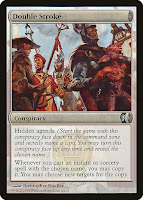
Examples of cards that affect the drafting itself:

Examples of conspiracy cards:

Wizards released two Conspiracy sets:
I've never played, but am intrigued and would love to try someday, if they release a third set in this vein.

Wednesday, December 29, 2021

Cubes

Logo from Cube Cobra, a go-to site for Magic Cube design

I've been sputtering over this holiday season as I explore a concept new to me in Magic: a Cube.

A Cube is "a collection of cards used for drafting and playing limited." This quote (and a great introduction to the format) is from this official link. In other words, a Cube is where you create your own set of Magic cards (from the existing card pool) and put it into packs to play draft or sealed with a group of friends. You could take the 'best of' from different Magic sets, or explore specific themes, or whatever you like. You could build a pauper Cube (meaning the cards are cheap- probably commons), a powerful Cube (everything is high-octane), or whatever you like. It sounds amazing. And like a lot of work to design and pack.

Design
Most Cubes are singleton for whatever reason (balance, per the article, but I'm not sure I buy that), which means there is only one copy of any given card. Common Cube sizes are 360, 540, or 720 cards (this does not count basic lands- those are never drafted, only added at the end as each player makes their deck). 360-card Cubes appear to be the minimum size, enabling eight players to draft with three packs of 15 cards each (like a typical draft experience). A 720-card Cube would enable multiple drafts for that number of players without 'resetting' (reshuffling and re-packing the cards).

The goal in design, per Tolarian Community College (see Resources below), is that "everything is awesome." In other words, create a card pool where every card has value [in this particular format]. Anyone who's done a traditional Magic draft knows that some cards just aren't good for drafting. Customization allows you to avoid those and focus on the gold.

Pack
Once you have your Cube, you have to pack it, meaning randomizing the cards and putting them into 15-card packs so it can be drafted or used for sealed play. Most people first sleeve the cards, and then use plastic pack boxes like Cubeamajigs or Dragon Shield Cube Shells to hold the packs. I've used the former, and it is nice- if time-consuming- to do this. Especially as you'd have to re-pack the cards after every draft.

Resources
In addition to the earlier link, I recommend Tolarian Community College's introductory videos on Cubes (here and here). Cube Cobra is the go-to site for Cube ideas, with thousands of user-created Cubes for every taste and budget. 

Personal Goal
Cubes have been around for a long time, apparently. But I've never designed, built, or drafted one. I'd like that to change this year. I want to build a Cube that I keep over several drafts and continually evolve. Right now, the French Vanilla cube at Cube Cobra is my model. This 540-card Cube focuses on basics with a little bit of 'flair,' but not much. Perfect for newer players or people like me that like to focus on the core of the game. I'm looking at that design and merging it with my general love of core sets to produce something that will (hopefully) be fun and enjoyable for both new players and veterans. We'll see.

Sunday, June 20, 2021

Jumpstart Event


Arena is running another Jumpstart event. Released last year, this fun format- "pick two 20-card theme packs, shuffle, and play"- is a hit, and I was glad to see it return. This time around, I played 36 games using 12 combinations. I went 16-20. Here are the stats:

Rainbow Discarding: 4-0
Tree-hugging Cats: 2-0
Goblins Minions: 0-2
Rogues Minotaurs: 1-1
Sea Spirits: 0-3
Devilish Plus One: 1-1
Legion Dinosaurs: 1-1
Well-Read Basri: 2-1
Vampire Elves: 1-2
Goblin Witchcraft: 1-2
Enchanted Vampires: 1-3
Milling Reanimated: 2-4

And here are some of the decks:

Rainbow Discarding:
1 Maelstrom Archangel (JMP) 454
1 Chamber Sentry (JMP) 461
1 Dinrova Horror (JMP) 450
1 Fusion Elemental (JMP) 451
1 Mirrodin's Core (JMP) 492
1 Raging Regisaur (JMP) 455
1 Ironroot Warlord (JMP) 452
1 Alloy Myr (JMP) 457
1 Auger Spree (JMP) 449
1 Terramorphic Expanse (JMP) 78
1 Lawmage's Binding (JMP) 453
1 Prophetic Prism (JMP) 478
1 Rupture Spire (JMP) 495
1 Skittering Surveyor (JMP) 486
1 Prismite (M21) 235
1 Forest (M21) 273
1 Island (M21) 265
1 Mountain (M21) 271
1 Plains (M21) 260
1 Swamp (M21) 268
1 Tinybones, Trinket Thief (JMP) 17
1 Assassin's Strike (JMP) 200
1 Fell Specter (JMP) 233
1 Ravenous Chupacabra (JMP) 269
1 Entomber Exarch (JMP) 227
1 Mind Rot (M21) 115
1 Burglar Rat (JMP) 214
1 Death's Approach (JMP) 222
1 Phyrexian Rager (JMP) 266
1 Slate Street Ruffian (JMP) 279
1 Thriving Moor (JMP) 37
1 Wight of Precinct Six (JMP) 287
1 Swamp (JMP) 55
1 Swamp (JMP) 55
1 Swamp (JMP) 55
1 Swamp (JMP) 55
1 Swamp (JMP) 55
1 Swamp (JMP) 55
1 Swamp (JMP) 55

Tree-hugging Cats:
1 Primordial Sage (JMP) 422
1 Burlfist Oak (M21) 174
1 Warden of the Woods (M21) 213
1 Nature's Way (JMP) 412
1 Wall of Blossoms (JMP) 442
1 Llanowar Visionary (M21) 193
1 Snarespinner (M21) 207
1 Ambassador Oak (JMP) 375
1 Crushing Canopy (JMP) 386
1 Explore (JMP) 393
1 Thriving Grove (JMP) 34
1 Wildsize (JMP) 445
1 Gnarled Sage (M21) 187
1 Forest (JMP) 70
1 Forest (JMP) 70
1 Forest (JMP) 70
1 Forest (JMP) 70
1 Forest (JMP) 70
1 Forest (JMP) 70
1 Forest (JMP) 70
1 Feline Sovereign (M21) 180
1 Enlarge (JMP) 392
1 Keeper of Fables (JMP) 407
1 Nature's Way (JMP) 412
1 Canopy Stalker (M21) 175
1 Sabertooth Mauler (M21) 202
1 Pridemalkin (M21) 196
1 Crushing Canopy (JMP) 386
1 Feral Invocation (JMP) 396
1 Initiate's Companion (JMP) 403
1 Pouncing Cheetah (JMP) 419
1 Thriving Grove (JMP) 34
1 Feral Prowler (JMP) 397
1 Forest (JMP) 74
1 Forest (JMP) 74
1 Forest (JMP) 74
1 Forest (JMP) 74
1 Forest (JMP) 74
1 Forest (JMP) 74
1 Forest (JMP) 74

Goblins Minions:
1 Muxus, Goblin Grandee (JMP) 24
1 Battle-Rattle Shaman (M21) 130
1 Beetleback Chief (JMP) 294
1 Goblin Commando (JMP) 325
1 Makeshift Munitions (JMP) 348
1 Burn Bright (M21) 134
1 Goblin Arsonist (M21) 147
1 Boggart Brute (JMP) 299
1 Goblin Instigator (JMP) 327
1 Goblin Shortcutter (JMP) 330
1 Ornery Goblin (JMP) 353
1 Outnumber (JMP) 354
1 Thriving Bluff (JMP) 33
1 Mountain (JMP) 65
1 Mountain (JMP) 65
1 Mountain (JMP) 65
1 Mountain (JMP) 65
1 Mountain (JMP) 65
1 Mountain (JMP) 65
1 Mountain (JMP) 65
1 Ghoulcaller Gisa (JMP) 236
1 Witch's Cauldron (M21) 129
1 Eliminate (M21) 97
1 Goremand (M21) 101
1 Liliana's Devotee (M21) 109
1 Innocent Blood (JMP) 244
1 Fetid Imp (M21) 98
1 Dutiful Attendant (JMP) 226
1 Ghoulcaller's Accomplice (JMP) 237
1 Nocturnal Feeder (JMP) 16
1 Shambling Goblin (JMP) 277
1 Thriving Moor (JMP) 37
1 Village Rites (M21) 126
1 Swamp (JMP) 54
1 Swamp (JMP) 54
1 Swamp (JMP) 54
1 Swamp (JMP) 54
1 Swamp (JMP) 54
1 Swamp (JMP) 54
1 Swamp (JMP) 54

Rogues Minotaurs:
1 Gonti, Lord of Luxury (JMP) 240
1 Thieves' Guild Enforcer (M21) 125
1 Audacious Thief (JMP) 84
1 Oona's Blackguard (JMP) 261
1 Rogue's Gloves (JMP) 479
1 Stab Wound (JMP) 281
1 Alchemist's Gift (M21) 87
1 Masked Blackguard (M21) 113
1 Lawless Broker (JMP) 249
1 Finishing Blow (M21) 99
1 Nightshade Stinger (JMP) 258
1 Nocturnal Feeder (JMP) 16
1 Thriving Moor (JMP) 37
1 Swamp (JMP) 57
1 Swamp (JMP) 57
1 Swamp (JMP) 57
1 Swamp (JMP) 57
1 Swamp (JMP) 57
1 Swamp (JMP) 57
1 Swamp (JMP) 57
1 Rageblood Shaman (JMP) 357
1 Sethron, Hurloon General (JMP) 25
1 Unleash Fury (M21) 170
1 Traitorous Greed (M21) 166
1 Bloodrage Brawler (JMP) 296
1 Soul Sear (M21) 160
1 Sure Strike (M21) 163
1 Borderland Minotaur (JMP) 301
1 Flurry of Horns (JMP) 321
1 Lightning Visionary (JMP) 22
1 Minotaur Skullcleaver (JMP) 349
1 Minotaur Sureshot (JMP) 350
1 Thriving Bluff (JMP) 33
1 Mountain (JMP) 69
1 Mountain (JMP) 69
1 Mountain (JMP) 69
1 Mountain (JMP) 69
1 Mountain (JMP) 69
1 Mountain (JMP) 69
1 Mountain (JMP) 69

Devilish Plus One:
1 Brash Taunter (M21) 133
1 Traitorous Greed (M21) 166
1 Dance with Devils (JMP) 306
1 Chained Brute (JMP) 19
1 Spiteful Prankster (JMP) 26
1 Havoc Jester (M21) 149
1 Hobblefiend (M21) 152
1 Pitchburn Devils (M21) 156
1 Act of Treason (JMP) 289
1 Collateral Damage (JMP) 305
1 Lightning-Core Excavator (JMP) 32
1 Thriving Bluff (JMP) 33
1 Torch Fiend (JMP) 367
1 Mountain (JMP) 63
1 Mountain (JMP) 63
1 Mountain (JMP) 63
1 Mountain (JMP) 63
1 Mountain (JMP) 63
1 Mountain (JMP) 63
1 Mountain (JMP) 63
1 Rishkar, Peema Renegade (JMP) 425
1 Invigorating Surge (M21) 190
1 Wildwood Scourge (M21) 214
1 Inspiring Call (JMP) 404
1 Nessian Hornbeetle (JMP) 413
1 Trufflesnout (M21) 212
1 Hunter's Edge (M21) 189
1 Pridemalkin (M21) 196
1 Arbor Armament (JMP) 376
1 Fertilid (JMP) 398
1 Pollenbright Druid (JMP) 173
1 Thriving Grove (JMP) 34
1 Forest (JMP) 72
1 Forest (JMP) 72
1 Forest (JMP) 72
1 Forest (JMP) 72
1 Forest (JMP) 72
1 Forest (JMP) 72
1 Forest (JMP) 72
1 Forest (JMP) 72

Legion Dinosaurs:
1 Blessed Sanctuary (JMP) 1
1 Selfless Savior (M21) 36
1 Falconer Adept (M21) 18
1 Banishing Light (JMP) 4
1 Basri's Solidarity (M21) 10
1 Valorous Steed (M21) 42
1 Daybreak Charger (M21) 14
1 Makeshift Battalion (M21) 26
1 Inspired Charge (JMP) 110
1 Knight of the Tusk (JMP) 114
1 Legion's Judgment (M21) 24
1 Thriving Heath (JMP) 35
1 Raise the Alarm (JMP) 129
1 Plains (JMP) 38
1 Plains (JMP) 38
1 Plains (JMP) 38
1 Plains (JMP) 38
1 Plains (JMP) 38
1 Plains (JMP) 38
1 Plains (JMP) 38
1 Primal Might (M21) 197
1 Rampaging Brontodon (JMP) 423
1 Drover of the Mighty (JMP) 388
1 Savage Stomp (JMP) 427
1 Thrashing Brontodon (M21) 209
1 Garruk's Uprising (M21) 186
1 Colossal Dreadmaw (M21) 176
1 Commune with Dinosaurs (JMP) 384
1 New Horizons (JMP) 414
1 Orazca Frillback (JMP) 416
1 Thriving Grove (JMP) 34
1 Ornery Dilophosaur (M21) 194
1 Drowsing Tyrannodon (M21) 178
1 Forest (JMP) 73
1 Forest (JMP) 73
1 Forest (JMP) 73
1 Forest (JMP) 73
1 Forest (JMP) 73
1 Forest (JMP) 73
1 Forest (JMP) 73

Well-Read Basri:
1 Basri Ket (M21) 7
1 Basri's Lieutenant (M21) 9
1 Tempered Veteran (M21) 41
1 Siege Striker (M21) 37
1 Faith's Fetters (M21) 17
1 Basri's Solidarity (M21) 10
1 Concordia Pegasus (M21) 12
1 Feat of Resistance (M21) 19
1 Staunch Shieldmate (M21) 39
1 Knight of the Tusk (JMP) 114
1 Legion's Judgment (M21) 24
1 Thriving Heath (JMP) 35
1 Basri's Acolyte (M21) 8
1 Plains (M21) 309
1 Plains (M21) 309
1 Plains (M21) 309
1 Plains (M21) 309
1 Plains (M21) 309
1 Plains (M21) 309
1 Plains (M21) 309
1 Ormos, Archive Keeper (JMP) 13
1 Tolarian Kraken (M21) 80
1 Arcane Encyclopedia (JMP) 459
1 Curiosity (JMP) 147
1 Oneirophage (JMP) 162
1 Capture Sphere (M21) 47
1 Tome Anima (M21) 81
1 Library Larcenist (M21) 55
1 Rousing Read (M21) 67
1 Opt (M21) 59
1 Erratic Visionary (JMP) 150
1 Runed Servitor (JMP) 481
1 Thriving Isle (JMP) 36
1 Island (JMP) 53
1 Island (JMP) 53
1 Island (JMP) 53
1 Island (JMP) 53
1 Island (JMP) 53
1 Island (JMP) 53
1 Island (JMP) 53

Vampire Elves:
1 Exquisite Blood (JMP) 231
1 Sangromancer (JMP) 272
1 Silversmote Ghoul (M21) 122
1 Bloodbond Vampire (JMP) 209
1 Gifted Aetherborn (JMP) 239
1 Sengir Vampire (JMP) 275
1 Sanguine Indulgence (M21) 121
1 Agonizing Syphon (JMP) 199
1 Last Gasp (JMP) 247
1 Nocturnal Feeder (JMP) 16
1 Thriving Moor (JMP) 37
1 Vampire Neonate (JMP) 285
1 Gloom Sower (M21) 100
1 Swamp (JMP) 60
1 Swamp (JMP) 60
1 Swamp (JMP) 60
1 Swamp (JMP) 60
1 Swamp (JMP) 60
1 Swamp (JMP) 60
1 Swamp (JMP) 60
1 Craterhoof Behemoth (JMP) 385
1 Elvish Archdruid (JMP) 391
1 Skyway Sniper (M21) 206
1 Dwynen's Elite (JMP) 389
1 Ghirapur Guide (JMP) 400
1 Silhana Wayfinder (JMP) 430
1 Llanowar Visionary (M21) 193
1 Hunter's Edge (M21) 189
1 Titanic Growth (M21) 210
1 Crushing Canopy (JMP) 386
1 Presence of Gond (JMP) 420
1 Thriving Grove (JMP) 34
1 Wildheart Invoker (JMP) 444
1 Forest (JMP) 77
1 Forest (JMP) 77
1 Forest (JMP) 77
1 Forest (JMP) 77
1 Forest (JMP) 77
1 Forest (JMP) 77
1 Forest (JMP) 77

Goblin Witchcraft:
1 Goblin Chieftain (JMP) 324
1 Goblin Goon (JMP) 326
1 Beetleback Chief (JMP) 294
1 Goblin Commando (JMP) 325
1 Makeshift Munitions (JMP) 348
1 Volley Veteran (JMP) 369
1 Goblin Arsonist (M21) 147
1 Shock (M21) 159
1 Boggart Brute (JMP) 299
1 Goblin Instigator (JMP) 327
1 Goblin Shortcutter (JMP) 330
1 Ornery Goblin (JMP) 353
1 Thriving Bluff (JMP) 33
1 Mountain (JMP) 65
1 Mountain (JMP) 65
1 Mountain (JMP) 65
1 Mountain (JMP) 65
1 Mountain (JMP) 65
1 Mountain (JMP) 65
1 Mountain (JMP) 65
1 Bogbrew Witch (JMP) 211
1 Witch of the Moors (JMP) 18
1 Blood Divination (JMP) 207
1 Bubbling Cauldron (JMP) 460
1 Swarm of Bloodflies (JMP) 282
1 Tempting Witch (JMP) 283
1 Bake into a Pie (JMP) 201
1 Black Cat (JMP) 203
1 Bloodhunter Bat (JMP) 210
1 Festering Newt (JMP) 234
1 Last Gasp (JMP) 247
1 Thriving Moor (JMP) 37
1 Swamp (JMP) 59
1 Swamp (JMP) 59
1 Swamp (JMP) 59
1 Swamp (JMP) 59
1 Swamp (JMP) 59
1 Swamp (JMP) 59
1 Swamp (JMP) 59

Goblin Vampires:
1 Muxus, Goblin Grandee (JMP) 24
1 Battle-Rattle Shaman (M21) 130
1 Beetleback Chief (JMP) 294
1 Goblin Commando (JMP) 325
1 Makeshift Munitions (JMP) 348
1 Burn Bright (M21) 134
1 Goblin Arsonist (M21) 147
1 Boggart Brute (JMP) 299
1 Goblin Instigator (JMP) 327
1 Goblin Shortcutter (JMP) 330
1 Ornery Goblin (JMP) 353
1 Outnumber (JMP) 354
1 Thriving Bluff (JMP) 33
1 Mountain (JMP) 65
1 Mountain (JMP) 65
1 Mountain (JMP) 65
1 Mountain (JMP) 65
1 Mountain (JMP) 65
1 Mountain (JMP) 65
1 Mountain (JMP) 65
1 Exquisite Blood (JMP) 231
1 Sangromancer (JMP) 272
1 Silversmote Ghoul (M21) 122
1 Bloodbond Vampire (JMP) 209
1 Gifted Aetherborn (JMP) 239
1 Sengir Vampire (JMP) 275
1 Sanguine Indulgence (M21) 121
1 Agonizing Syphon (JMP) 199
1 Last Gasp (JMP) 247
1 Nocturnal Feeder (JMP) 16
1 Thriving Moor (JMP) 37
1 Vampire Neonate (JMP) 285
1 Gloom Sower (M21) 100
1 Swamp (JMP) 60
1 Swamp (JMP) 60
1 Swamp (JMP) 60
1 Swamp (JMP) 60
1 Swamp (JMP) 60
1 Swamp (JMP) 60
1 Swamp (JMP) 60

Goblin Pirates:
1 Muxus, Goblin Grandee (JMP) 24
1 Beetleback Chief (JMP) 294
1 Goblin Commando (JMP) 325
1 Makeshift Munitions (JMP) 348
1 Volley Veteran (JMP) 369
1 Goblin Arsonist (M21) 147
1 Shock (M21) 159
1 Boggart Brute (JMP) 299
1 Goblin Instigator (JMP) 327
1 Goblin Shortcutter (JMP) 330
1 Ornery Goblin (JMP) 353
1 Outnumber (JMP) 354
1 Thriving Bluff (JMP) 33
1 Mountain (JMP) 65
1 Mountain (JMP) 65
1 Mountain (JMP) 65
1 Mountain (JMP) 65
1 Mountain (JMP) 65
1 Mountain (JMP) 65
1 Mountain (JMP) 65
1 Corsair Captain (JMP) 11
1 Chart a Course (JMP) 142
1 Curious Obsession (JMP) 148
1 Departed Deckhand (JMP) 149
1 Spectral Sailor (JMP) 178
1 Capture Sphere (M21) 47
1 Kitesail Corsair (JMP) 155
1 Pirate's Cutlass (JMP) 477
1 Prosperous Pirates (JMP) 165
1 Rishadan Airship (JMP) 170
1 Sailor of Means (JMP) 172
1 Thriving Isle (JMP) 36
1 Read the Tides (M21) 62
1 Island (JMP) 52
1 Island (JMP) 52
1 Island (JMP) 52
1 Island (JMP) 52
1 Island (JMP) 52
1 Island (JMP) 52
1 Island (JMP) 52

Milling Reanimated:

Fun times! I hope they run it again in the future (or, better- come out with Jumpstart 2).